




Every furniture salesperson has heard the same three words at the same moment. The shopper loves the sectional, sits on it twice, checks the fabric, then looks at the tag and says it is too expensive. Nine times out of ten they do not mean the piece is not worth the money. They mean they cannot write that check this month.
Financing answers that objection, and almost every furniture store already has it. Affirm, Afterpay, Klarna, Synchrony, Acima, Progressive Leasing, Snap Finance: the agreements are signed and the tablet is on the counter. Then the store markets the whole thing with one grey line at the bottom of a page that reads financing available.
Financing shown as a monthly payment in the ad and on the product page is among the most reliable reasons a furniture ad gets a response, and most stores treat it as a footnote. Here is how to build it through the whole funnel, from the first impression to the sales floor, without promising anything you are not allowed to promise.
The short answer
Market financing the way you market a product. Pick one clear offer, translate every price into a monthly payment, and put that payment in the ad headline, on the product page, on the landing page, in the follow up message and on the showroom sign, using the same words in every place. Advertise the terms honestly and never promise approval to anyone. Then measure two things: the share of tickets that use financing, and the difference in average ticket between financed and cash sales. That second number is usually what pays for the program.
Why financing moves furniture when a discount does not
A discount changes the price. Financing changes the question the shopper is answering.
Cut ten percent off a sectional and the shopper still has to find most of the money this month. Put the same sectional in front of them as a payment that fits between the car and the phone bill, and the decision becomes whether they want it, not whether they can clear it. In a category where the ticket is high and the purchase is emotional, that is a far easier question to win.
It also matches how furniture is actually bought. This is a considered purchase: typically two to twelve weeks from the first search to the sale, mattresses at the short end, full rooms at the long end. During those weeks the shopper is deciding whether to buy now or wait for the bonus, the refund, the spring. Financing removes the reason to wait, and waiting is the competitor that beats you most often.
It protects margin too. Leading with payments instead of percentages trains your market to shop for the room it wants rather than for the deepest markdown.
Build the offer architecture before you build the ad
Most financing marketing fails at the planning stage, not the creative stage, because the store tries to advertise its whole lender lineup at once. Shoppers do not compare seven programs.
Pick one hero offer. Whatever your strongest promotional term is, that is the number your market hears from you. It goes in ads, on signs, on the website and in email. Everything else is a fallback the salesperson introduces in conversation.
Have a second path ready. Lease to own and second look programs are how you keep a customer who walked in ready to buy. They belong in the conversation and on the financing page, not in the headline.
Decide who owns it. One person has to own the terms, the disclosures, the creative refresh when a promotional period changes, and the reporting. In the accounts we manage, the stores that do this well have someone checking that the sign, the site and the ad still say the same thing.
The monthly payment is the headline number
A furniture price is a barrier. A furniture payment is an invitation. So the payment goes first.
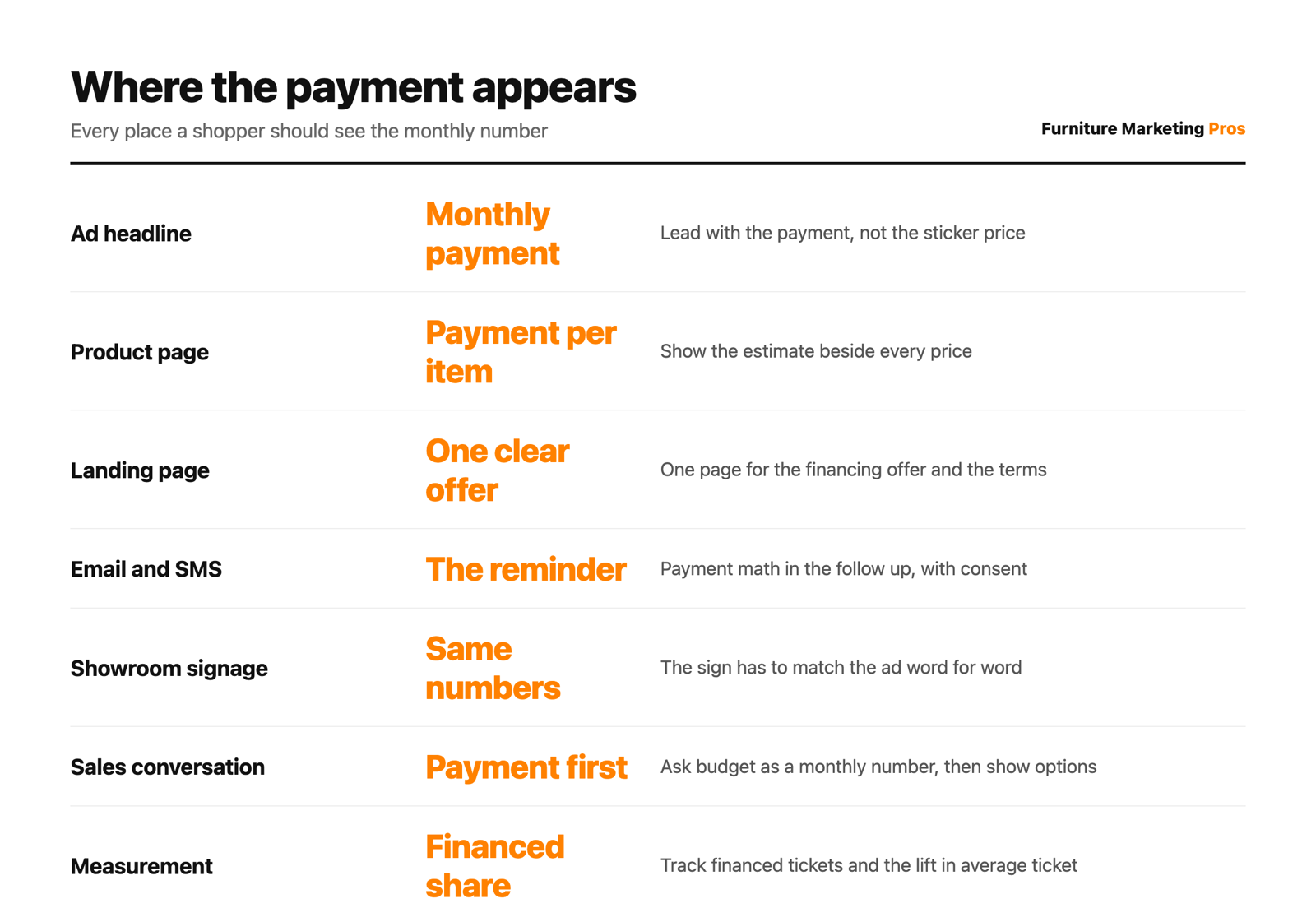
The estimate appears everywhere the price appears, at the same size and in the same eyeline, not in grey underneath. Ad headlines are built around the payment and the room rather than around the word financing, because nobody is shopping for financing. They are shopping for a living room they can afford this month.
The number has to be real. Use the estimate your lender's own calculator produces for the term you are promoting, show what it assumes, and update it when the program changes. A payment that turns out to be wrong at the counter costs you the sale and the review.
Say it honestly: the compliance basics in plain language
This is the part owners worry about, and the worry is healthy. Consumer credit advertising is regulated, and the safest posture is also the one that sells best: say exactly what is true.
Advertise terms honestly and completely. If you promote a specific term, rate or payment, the conditions around it have to be visible in the same place, in a size people can read.
Never promise approval. No ad, email, sign or salesperson should say approved or guaranteed. Prequalification language is the honest framing: see what you qualify for, check your options, apply in minutes. The decision belongs to the lender.
Do not imply everyone gets the best offer. The strongest promotional term is available to some applicants. Say so plainly rather than burying it.
Use your partners' approved language. Lenders have brand rules and required disclosures, and they will hand you copy blocks that already satisfy them.
None of this blunts the message. Honest terms in large type, with a prequalification link and no promises, beat vague copy, because the shopper's real fear is a surprise at the counter.
Financing in your Google and Meta ads
Paid media is where the payment does the most work, because that is the moment the shopper decides whether you are worth a click.
On Google, put the payment and the term into responsive search ad headlines for your high intent category terms, use promotion assets while a promotional period runs, and make the financing page a sitelink on every campaign. Build a small ad group set around the financing queries themselves, the searches that pair no credit needed, payment plans or monthly payments with your category and city, because those shoppers have already decided how they want to buy. Feed the same messaging into your Performance Max asset groups. Our Google Ads playbook for furniture stores covers the structure this slots into, and with Search clicks at a median of 2.10 dollars in our furniture accounts, a headline that answers the affordability question is the cheapest conversion improvement available.
On Meta, the payment belongs in the first line of the primary text and in the image or video itself, because most people never expand a caption. Catalog ads can carry it in the overlay so the number travels with the product. A fifteen second clip of your finance manager explaining what happens when someone applies, filmed on a phone on the sales floor, beats a designed graphic that says financing available. The piece on Meta AI ads for furniture stores covers how the automation handles that creative.
One caution. Financing should not be your only angle. It is one of three or four rotating messages, alongside delivery, selection and the sale window.
Product pages and landing pages that carry the payment
The ad gets the click. The page decides everything after it.
On every product page the payment estimate sits directly under the price, with a link that explains the program in one screen. On category pages it appears in the product tile. In the cart and on the quote form it appears again with the prequalification link.
Then build one real financing page. Not a policy page: a landing page. What the offer is, what it costs, who the partners are, how long an application takes, what to bring to the showroom, and a single obvious action. Answer the questions a nervous shopper actually has and you convert people who would otherwise close the tab. Send every financing ad there, not to a homepage that makes them hunt.
If the application opens in a broken frame on a phone, you have lost the customer who needed it most. We covered the wider version of this in turning your furniture store website into a lead machine, and the financing path is the part of the site most worth testing on a real phone once a quarter.
The sequence that turns a maybe into a yes
Almost nobody applies on the first visit. They look, they leave, they think, and the store that stays present gets the sale four weeks later. Email and SMS is routinely a 20 to 30 percent revenue channel for furniture retailers that run it properly, and financing gives those messages something to say beyond another sale announcement. Three flows carry most of the value.
The browse and cart follow up. The piece they looked at, with the payment estimate and the prequalification link. One email in the first day, a second a few days later with the delivery and warranty answers, and a text only if they opted in.
The financing nurture. For anyone who visited the financing page or started an application without finishing, a short sequence that answers the fear rather than pushing the offer: how long it takes, what happens if the answer is no.
The promotional period reminder. A promotional term that is ending is a real deadline, and it is allowed to sound like one.
Retargeting carries the same message on the paid side, with the payment in the creative for anyone who viewed a product and did not buy, which is where the retargeting playbook and the financing plan overlap. Run email and SMS as part of the same system as the ads.
The showroom, the signage and the sales conversation
Online and in store have to tell the same story, because the shopper checks.
Put the payment on the window, on the price tags, on the tent cards in each room setting and on the counter, using the same number the ads use. A shopper who saw one payment on Instagram and a different one on the tag stops trusting both.
On the floor, timing matters. Financing introduced at the start feels like an assumption about the customer's means. Financing introduced after the objection feels like a rescue. Train the team to ask about budget as a monthly number once the shopper has chosen the room they want, then show two options rather than seven.
Every conversation that ends without a sale should still end with a captured email or phone number, with permission, so the sequence above has somewhere to go.
How to measure financed share and ticket lift
Financing marketing is easy to measure once you decide what you are measuring.
Financed share of tickets. What percentage of sales use a financing program, by month and by category. This is your adoption number.
Average ticket, financed against cash. The most useful figure in the program. If the financed ticket is meaningfully larger, financing is not costing you margin, it is buying you volume you would not otherwise see.
Application starts and completions. Tracked on the site as conversions so your campaigns can optimize toward them, and reconciled against the lender's own portal.
This reporting usually does not exist because the sale happens in the showroom, the marketing happens online, and nothing joins the two. A CRM built for furniture retail closes that loop: the lead from the financing ad, the showroom visit, the ticket and whether it was financed, in one record. Without it you are guessing, and the guess is usually that financing does nothing.
Where this fits with the rest of your advertising
Financing is not a campaign. It is a layer running through the campaigns you already have: the Google ads that capture demand, the Meta ads that create it, the retargeting that keeps the conversation alive. Keeping that layer consistent, with the terms right and the numbers matching everywhere, is much of what day to day paid ads management actually involves. If you want a second opinion on how your offer is presented today, book a strategy call and we will walk your ads, your product pages and your showroom signage together.
Key takeaways
- A discount changes the price, financing changes the question, and in high ticket furniture the second one wins more often.
- Pick one hero offer and one fallback path, then say the same thing in the ad, on the page, in the email and on the sign.
- The monthly payment is the headline number and belongs everywhere the price appears, at the same size.
- Advertise terms honestly, never promise approval, and use the language your lending partners already supply.
- Build one financing landing page that answers a nervous shopper's questions and works on a phone.
- Measure financed share of tickets and the gap between financed and cash average ticket.
Frequently asked questions
Does advertising financing attract customers who cannot afford to buy?
In practice it mostly reaches people who can buy but would rather not pay all at once, which is a large share of furniture shoppers. Lead with the room and the payment together rather than with credit language and the response stays qualified.
Which financing partner should a furniture store promote?
Promote whichever program gives you the strongest promotional term for your typical ticket, and keep a second look or lease to own option in reserve for the shopper it does not fit. Shoppers understand one offer at a time.
Can I say approved or guaranteed in my ads?
No. Approval is the lender's decision, and promising it is both a compliance problem and a trust problem when the answer turns out differently. Use prequalification language instead: see your options, check what you qualify for, apply in minutes.
Where should financing ads send traffic?
To a dedicated financing landing page that explains the offer, the terms and the next step in one screen, not to your homepage. Product pages should carry the payment estimate too.
How do I know whether financing marketing is working?
Track the financed share of tickets and the average ticket on financed sales against cash sales, month by month, and count application starts as a conversion in your ad accounts. If the financed ticket is larger and adoption is climbing, it is working.