




Furniture demand is not flat and never has been. Most owners know that from the sales floor, yet almost every ad account we take over runs the same budget in February as in November, which means overpaying in the quiet months and running underfunded in the weeks that decide the year.
We pulled twelve months of Google Ads data across fifteen furniture and mattress client accounts, September 2025 through August 2026, and the swing is larger than most owners expect. The busiest month drew more than seven times the impressions of the quietest. The most expensive click cost about eight times the cheapest. Those two curves do not move together, which is where the opportunity sits.
This is the calendar that comes out of that data: what to run each month, what to say, how to pace budget, and what to have ready two weeks before every window.
The short answer
Furniture demand peaks twice: the Labor Day run up in August and the Black Friday stretch in November, with Memorial Day in May as a strong third. Clicks are cheapest in spring and in November, and most expensive in January and February. So the plan is simple to state and hard to do: raise budgets two weeks before each window, spend hardest when demand and cheap clicks arrive together, stay lean in the expensive quiet months, and use the slow weeks to build the feeds, creative and email lists the busy weeks will consume.
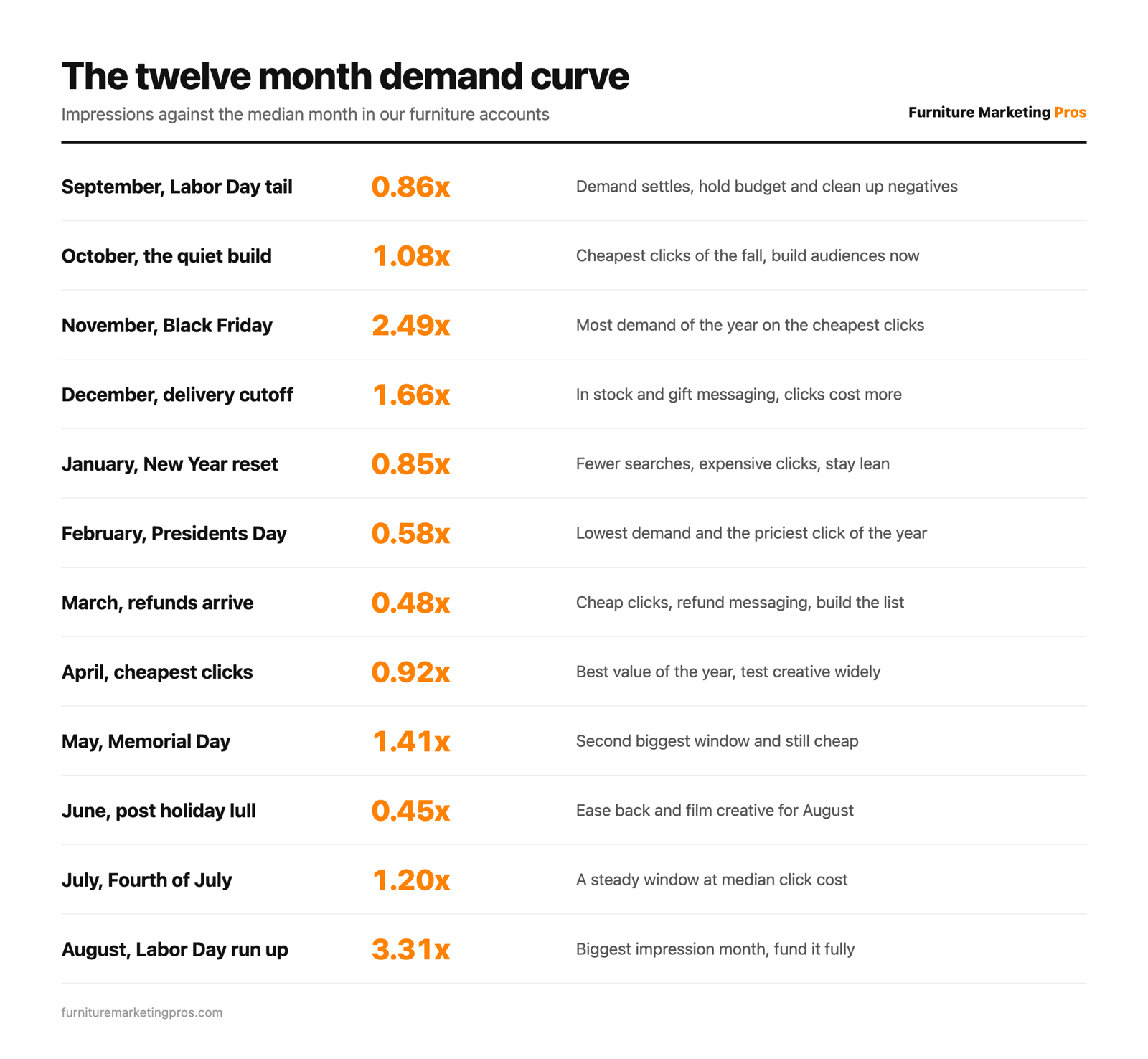
What a year of furniture demand actually looks like
Across the furniture Google Ads accounts we manage, measuring each month's impressions against the median month, the year runs like this. August 3.31, November 2.49, December 1.66, May 1.41, July 1.20, October 1.08, April 0.92, September 0.86, January 0.85, February 0.58, March 0.48, June 0.45.
Cost per click runs on a different rhythm. The median click across all campaign types was about 2.45 dollars. February was the most expensive month at 4.93 dollars and April the cheapest at 60 cents. November, the second busiest month, came in at 1.80 dollars, well below the median.
Read those two lines together and the strategy writes itself. November gives you the most demand of the year at a below median click cost, the best trade on the calendar. February gives the least demand at the highest cost, the worst. August gives enormous volume at roughly the median price, so it is worth funding heavily even though it is not cheap. Spring gives clicks at a quarter of the usual price, which makes it the moment to test creative and build audiences you will use later.
January and February: the priciest clicks of the year
January comes in at 0.85 of the median month with an average click of 3.46 dollars. February is worse on both counts: 0.58 of the median on a 4.93 dollar click, the lowest demand and the priciest click in the entire year.
That is not a reason to go dark. It is a reason to be selective. Run brand terms, your highest intent category searches and retargeting, and let the broad prospecting budget sit down. Presidents Day is a real furniture window and worth promoting, but the auction is crowded with national brands and the click price reflects it, so compete on offer and local proof rather than on bid.
Messaging works best following the season rather than fighting it. January is the fresh start month: new room, new mattress, the guest room you finally have to deal with. February is the sale month, and the moment financing messaging earns its keep.
It is also the right time for account maintenance. Rebuild ad copy, clean the feed, review negative keyword lists, and set up the conversion tracking you will need in spring. The work is cheap now because the traffic is thin.
March and April: refund money and the cheapest clicks of the year
March sits at 0.48 of the median, the second quietest month in the data, but the click price drops to 1.63 dollars. April is quieter than average too at 0.92, with a 60 cent click, the cheapest of the year by a wide margin.
Low demand plus very cheap traffic is an opportunity, not a dead zone. Tax refund season runs from mid February into April and it is real money for furniture, especially in value and mid market stores. Build campaigns around what a refund actually buys: a mattress set, a living room, the dining table before the family visits.
Spring is also when you test. New creative, new landing pages, new audience signals, new Performance Max asset groups. Testing in April costs a fraction of testing in December and the winners carry through the year. The same is true of prospecting: reaching cold audiences at a 60 cent click builds a retargeting pool you will monetize in May and again in the fall. Our retargeting playbook covers what to do with that pool.
May, June and July: Memorial Day, the lull and the Fourth
May is the third biggest month in the data at 1.41 of the median, and clicks were still cheap at 91 cents. That combination makes Memorial Day one of the best value windows of the year for a furniture store, and it is consistently underplayed compared with Black Friday.
Treat it like a real event. Outdoor furniture, mattresses and living room are the categories that move. Start the ramp two weeks out, run a clear offer with an end date, and put the showroom on every ad. Our post on furniture promotions that drive sales covers how to build an offer worth advertising.
June is the deepest trough of the year at 0.45 of the median with the click price back up to 2.59 dollars. Ease budgets back, keep brand and retargeting running, and use the month for production: film the room videos, the delivery stories and the customer interviews you will need in August. Creative made in June is what makes August work.
July recovers to 1.20 on a click at the median price. The Fourth is a genuine window, shorter and less dramatic than Memorial Day, and it pairs well with clearance on the summer categories you need to move before fall.
August: the biggest month in the data
August came in at 3.31 of the median month, the single largest impression month in the whole window and 2.8 times July. Clicks held at the median, 2.46 dollars. That is the Labor Day run up, and it is the most underestimated month in furniture advertising.
Almost nobody plans for it. Owners start thinking about Black Friday in October and wake up to the biggest demand of the year having already passed. Do the opposite: build the August plan in June, finish the creative in July and raise budgets in the last week of July so campaigns are out of the learning phase when the volume arrives.
Everything should be running. Performance Max with the full catalog, Search on brand and category, Meta prospecting and retargeting, email and SMS to the whole list. Mattresses and bedroom perform strongly into the back to school weeks, and Labor Day weekend is the single largest selling event many independents run.
Budget accordingly. If your annual paid media budget is split evenly across twelve months, you are funding a 0.45 month the same as a 3.31 month. Our furniture marketing budget guide covers the total. This is where a disproportionate share of it belongs.
September and October: the quiet build that decides November
September settles to 0.86 of the median at 2.69 dollars a click as the Labor Day tail fades. October recovers to 1.08 with clicks at 1.97 dollars, below the yearly median.
These are the most valuable planning weeks of the year. Everything November needs has to be finished before November starts: the feed clean and approved, the offers decided, the landing pages built, the creative shot and uploaded, the audiences and exclusions in place, the email and SMS flows written and scheduled.
October traffic is also cheap enough to prospect with intent. Build the audiences in October that you will retarget in November, and grow the email list hard, because owned channels are what make the holiday stretch profitable rather than merely busy. Email and SMS is routinely a 20 to 30 percent revenue channel for furniture retailers who run it properly, and the email and SMS side of the plan is where holiday margin is protected.
November and December: Black Friday to the delivery deadline
November is the best trade on the calendar: 2.49 of the median month, 2.3 times October's impressions, on the cheapest clicks of the fall at 1.80 dollars. The most demand of the year at a below median price. If you have one month to be aggressive, this is it.
Run the whole window, not the weekend. Early access for your email list, Black Friday, the weekend, Cyber Monday, and a closing push for the people who waited. Keep offers simple enough to say in an ad headline, and lead with in stock and delivery dates rather than price alone, because the online brands cannot promise a sofa in the living room by a specific date and you can. The Google Ads playbook covers the campaign structure that carries this load, and the Meta side covers the creative volume you will need to avoid fatigue in a four week sprint.
December stays strong at 1.66 of the median, but the click price jumps to 2.86 dollars, about 45 percent above October's. Demand shifts too. The first half is delivery deadline shopping, so every ad should carry a date by which an order arrives before the holiday. After that date passes, switch to accessories, gift cards and January mattress and bedroom messaging, and let the budget taper rather than fight for clicks you cannot fulfil.
What to prepare two weeks before every window
The pattern repeats for Presidents Day, Memorial Day, the Fourth, Labor Day and Black Friday, and the two week lead time is not optional. A budget raised on the morning of the sale spends the first three days learning.
- Raise budgets fourteen days out, in steps rather than one jump, so bidding stays stable.
- Have the offer decided, written and checked before the creative is produced.
- Ship creative in the formats each platform needs, with enough variations to last the window without fatigue.
- Build the landing page, then load it on a phone on store wifi before you send traffic to it.
- Schedule the email and SMS sends, including early access for your own list.
- Check the feed for disapprovals and stock accuracy, because a sale on items you cannot ship is worse than no sale.
- Confirm conversion tracking still fires, including calls, direction requests and quote forms.
- Brief the sales floor, so the ad and the greeting match.
Then ease back once the window closes. Budget left running at peak levels into the lull is the most common way furniture stores waste money.
A note for mattress stores
The pattern above is furniture wide. In the two mattress accounts inside this dataset, search clicks ran roughly 90 cents to 3 dollars across the year with no reliable seasonal curve at that sample size, so we will not publish a mattress table we cannot stand behind.
What we can say is that the mattress calendar leans on the same public windows, especially Presidents Day, Memorial Day and Labor Day, and that the mattress consideration cycle is shorter than the full room cycle, closer to two weeks than twelve. Mattress campaigns can be turned up later and turned down sooner than living room campaigns, and retargeting windows can be tighter.
Running the calendar
A seasonal calendar is easy to write and hard to keep. It means changing budgets on a schedule, finishing creative before it is needed, and holding your nerve in February when the account looks quiet. That discipline, month after month, is most of what paid ads management actually is. If you want us to map your account against this curve and show you where the money is sitting in the wrong month, book a strategy call.
Key takeaways
- Furniture demand swings hard: August ran 3.31 times the median month in our accounts and June ran 0.45.
- The two peaks are the Labor Day run up in August and the Black Friday stretch in November, with Memorial Day third.
- Demand and click cost move on different curves, so November and May are the best value windows and February the worst.
- Raise budgets fourteen days before every window so campaigns are out of the learning phase when traffic arrives.
- Use the cheap quiet months for testing, prospecting and list building rather than going dark.
- Finish the feed, creative, pages and email sends in October, because November has no time for preparation.
Frequently asked questions
When should a furniture store start its Black Friday advertising?
Preparation starts in October and budgets start rising in the middle of November, about two weeks before the weekend. November drew 2.49 times the median month's impressions in our accounts on below median click costs, so the whole month deserves funding, not only the weekend itself.
Is August really bigger than Black Friday for furniture stores?
In our accounts, by impressions, yes. August ran at 3.31 of the median month against November's 2.49, driven by the Labor Day run up. Clicks cost more in August, so November is still the better value, but August is the bigger month and most stores underfund it.
Should I pause ads in the slow months?
No. Keep brand terms, high intent category searches and retargeting running year round, and reduce broad prospecting instead. Going dark loses the audience data and campaign history that makes the next window work.
Why are my furniture clicks so expensive in February?
Because demand is at its lowest and Presidents Day promotion crowds the auction at the same time. February averaged 4.93 dollars a click in our accounts against 60 cents in April. Compete on offer and local proof in February rather than on bid.
How much should budgets move between months?
Enough to follow the curve rather than spend a flat twelfth of the year each month. A practical starting point is to fund your two peak months at several times your quietest month, ramping fourteen days before each window and easing back after it.