




Most interior designers have never run a paid ad, and the ones who have usually tried it once, spent a few hundred dollars on a campaign that produced three people wanting a mood board for free, and concluded that ads do not work for design.
The referral engine is why. A good designer gets work from past clients, builders, showrooms and neighbors, and for years that is enough. Then the calendar develops gaps, or a referral partner retires, or you decide you want larger projects than the ones arriving by word of mouth, and there is no lever to pull.
Paid advertising is that lever, but only if it is built for how design work is actually bought. A homeowner choosing a designer is deciding who to trust in their house for a year. Ads do not close that decision. They start it, and then the qualification and the follow up do the rest.
The short answer
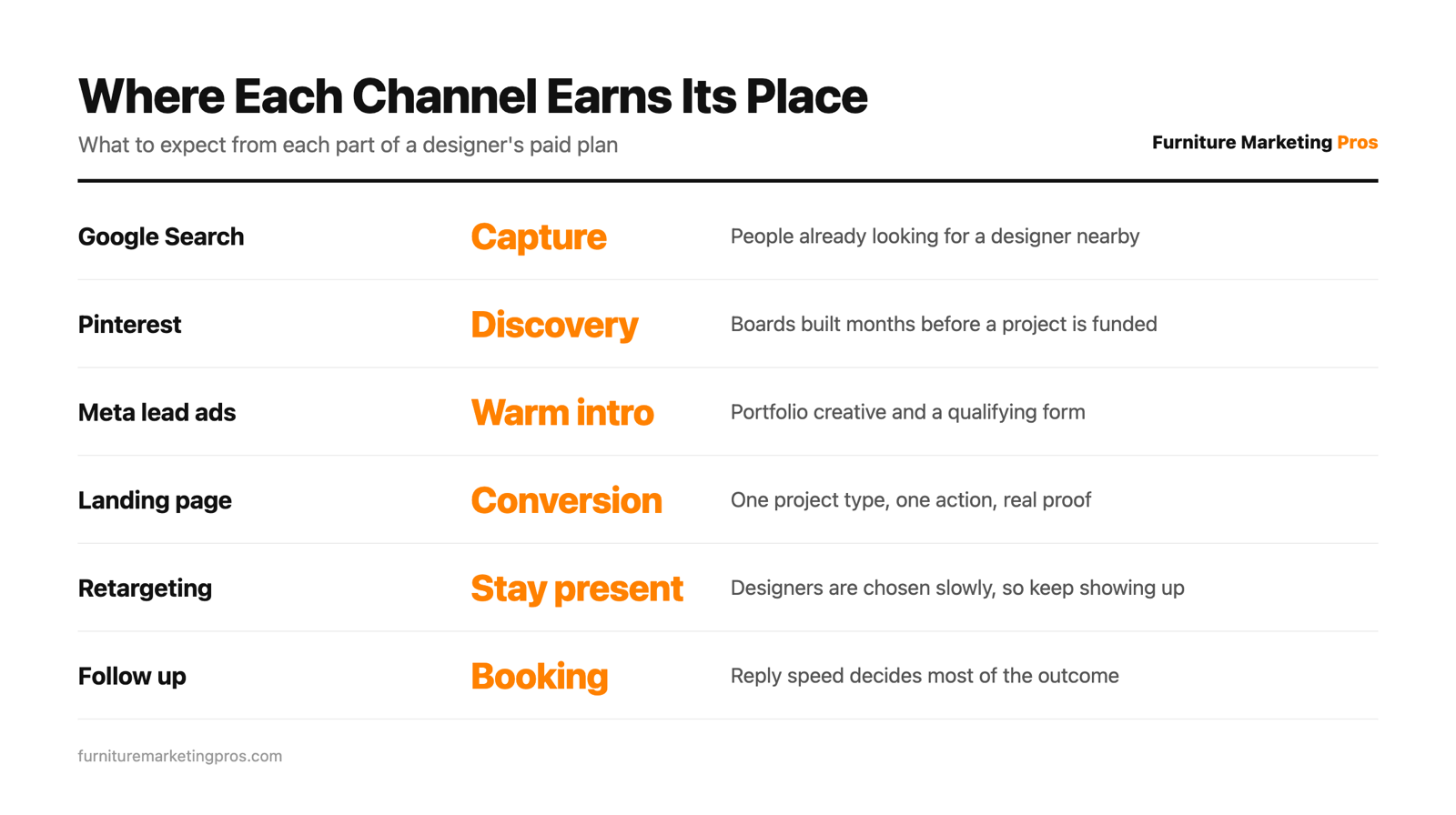
Paid ads work for designers when they are aimed at intent rather than at taste. Google Search captures homeowners already looking for a designer in your city. Pinterest reaches people planning a project months before they are ready. Meta lead ads turn portfolio imagery into a conversation. All three should land on a page built for one project type with one clear action, ask two or three questions that filter budget before the call, and feed a follow up sequence that assumes weeks of thinking rather than minutes. The ad buys attention. The process books the project.
Why referrals stop scaling, and what ads actually do
Referrals arrive on their own schedule and bring you the projects your network already knows you for. That is their strength and their ceiling.
Paid ads let you choose three things referrals never do. You choose the project type, because you can bid on kitchen renovation terms and not on apartment styling. You choose the geography, down to the neighborhoods where the work you want actually exists. And you choose the timing, so you can fill a quiet spring instead of waiting for the phone.
What ads do not do is shorten the trust decision. Our piece on digital marketing for interior designers makes the case that homeowners are looking for evidence of process far more than evidence of taste, and that is just as true of a paid click as an organic one. Everything below assumes the site behind the ad already answers that question.
Google Search: the queries worth paying for
Search is where the money is, because the person typing has already decided they want a designer.
Designer plus place. "Interior designer near me", "interior designer Dallas", "interior design firm in Bergen County". These are the core. Exact and phrase match, tight ad groups, ad copy that names the area and the kind of work you do.
Service plus city. "Kitchen designer Austin", "home renovation designer Chicago", "new build interior design Phoenix". Narrower, cheaper and often better, because the searcher has already named the project.
Project stage terms. "Interior design consultation", "interior designer for new construction", "designer for home remodel". These reach people at the exact moment they decide to hire rather than to browse.
Across the accounts we manage the median Search click runs about $2.10, and design terms sit near the higher end of that because the auction is thin but the intent is strong. That is expensive per click and cheap per project when a single project is worth what a design project is worth. The structure and settings we use are the same ones in our Google Ads playbook, scaled down to a service business.
The negatives that protect the budget
A designer's search campaign leaks in predictable places, and a negative keyword list fixes almost all of it in an afternoon.
Block the career searches: jobs, salary, hiring, internship, apprentice. Block the education searches: course, degree, school, certification, classes. Block the software searches: app, free tool, 3D planner, room planner. Block the do it yourself searches: free, cheap, DIY, ideas, templates, inspiration. And block the categories you do not serve, whether that is commercial work, staging, or office fit outs.
Then read the search terms report every single week for the first two months. In a low volume account like a designer's, five wasted clicks a day is a meaningful share of the budget, and nobody will tell you about them.
Pinterest and Meta: reaching people before they search
Search only finds people who are already looking. The other two platforms reach the much larger group who are planning.
Pinterest is where renovations are imagined. People build boards for a kitchen or a nursery months before they call anyone, and promoted pins put your work into those boards with a link back to the project it came from. Promote the images that already perform organically, send each one to the matching project page rather than the homepage, and treat Pinterest as a slow channel that fills the top of the pipeline rather than one that books next week.
Meta lead ads are the fastest way to turn a portfolio into conversations. A short video walking through a finished room, or a before and after carousel, with a form that opens inside the app. Keep the creative honest and specific to a project type, because a form filled in by someone who loved a beach house renovation is worth more than ten filled in by people who liked a pretty picture.
The trap with lead forms is that they are too easy. A one field form produces volume and wastes your week. Which brings us to the part most designers skip.
Qualification: ask the awkward questions in the form
The single biggest difference between a designer who likes paid ads and one who hates them is whether the form asks about budget.
Three or four questions, on the form or on the landing page, before anything reaches your inbox.
What is the project? A whole home, one room, a new build, a renovation. This alone sorts most of the traffic.
Where is it? So you can decline the ones outside your travel radius without a phone call.
What is the investment range? Offer ranges to choose from rather than an open box. People answer ranges honestly and abandon open boxes. If your minimum project is a certain size, say so in plain language on the page: it costs you a few enquiries and saves you a dozen calls.
When do you want to start? Now, in the next few months, still planning. This decides which follow up sequence they enter, not whether you talk to them.
Yes, you will get fewer leads. You will also stop spending Thursday evenings on calls with people who wanted a color consultation. Every furniture and design client we work with who has added budget qualification has ended up with fewer and better conversations.
The landing page and the consultation booking
Never send paid traffic to a homepage. It asks the visitor to work out where to go, and paid visitors do not work.
Build one page per project type, and give each one the same skeleton: a headline that names the project and the place, three or four images from one completed job rather than thirty from thirty, a short description of how you work and what the stages are, a named price or investment range or at minimum a clear statement of your minimum, proof in the form of a client quote and a real name, and one action.
That action should be a booking, not a contact form. A calendar where someone picks a consultation slot converts better than a form that promises a reply, because it gives an anxious homeowner a defined next step. The page has to be fast and it has to work on a phone, since most of your Pinterest and Meta traffic will arrive there. This is the work we cover under website and conversion development, and our guide to turning a site into a lead machine rather than a brochure applies to a design studio almost line for line.
Follow up, where most of the money is made or lost
Design projects are chosen slowly. Someone enquires in March about a kitchen they start in September, and the designer who is still politely present in September gets the job.
Reply within the hour, by phone if they left a number and by email if they did not. Send a short project relevant case study within two days. Then run a simple sequence over the following weeks: how you work, what a typical timeline looks like, what things cost and why, one finished project in their category, and a light check in every few weeks after that.
All of it belongs in one system, so nothing depends on a designer remembering to follow up between site visits. That is the job of a CRM. Alongside it, run retargeting to the people who visited a project page and did not book, on the same unhurried logic we use for long consideration purchases in retargeting for furniture stores. Lower frequency, project stories rather than offers, and stop the moment someone books.
What to budget: our practical starting points
These are the numbers we start people at, not industry benchmarks. Adjust for your market and your minimum project size.
A solo designer usually starts at roughly $800 to $1,500 a month in media, put almost entirely into Google Search in a tight radius, plus whatever it costs to run a booking page. One channel, done properly, beats three channels starved.
A small firm with a team and capacity to fill usually starts at roughly $2,500 to $5,000 a month, split across Search, a retargeting layer, and one discovery channel, most often Pinterest or Meta lead ads depending on where the work is visual enough to travel.
In both cases, commit for a full quarter. A designer's account is low volume by nature, so a month of data is noise, and you need enough enquiries to see which project types and which neighborhoods are actually producing work.
Where this fits, and how we help
Interior design is close enough to furniture retail that the same discipline applies: choose the intent, qualify hard, land on a page built for one decision, and follow up for as long as the decision takes. Building and running that across Google, Pinterest and Meta is what paid ads management looks like for a design studio. If you want to know whether paid ads are worth it for the kind of projects you want more of, book a strategy call and we will go through your market with you.
Key takeaways
- Referrals bring the projects your network already knows you for, and paid ads let you choose the project type, the geography and the timing instead.
- Google Search captures homeowners who have already decided to hire, using designer plus place, service plus city and project stage terms.
- A negative keyword list blocking jobs, courses, software and do it yourself searches saves a large share of a small budget.
- Pinterest reaches people planning months ahead and Meta lead ads turn portfolio work into conversations, as long as the form qualifies.
- Ask about project type, location, investment range and timing before the lead reaches your inbox, and accept fewer and better enquiries.
- Send paid traffic to a project specific page with a booking calendar, then follow up for weeks, because design is chosen slowly.
Frequently asked questions
Do Google Ads work for interior designers?
Yes, when they are pointed at hiring intent rather than at inspiration. Designer plus city, service plus city and consultation terms produce enquiries from people who have already decided to hire, and a tight negative keyword list keeps students, job seekers and browsers out of the budget.
How much should an interior designer spend on ads each month?
As a practical starting point we use roughly $800 to $1,500 a month for a solo designer concentrated on Google Search, and roughly $2,500 to $5,000 for a small firm across search, retargeting and one discovery channel. Commit for a quarter, because design accounts are low volume and a single month tells you very little.
Are Pinterest ads worth it for a design studio?
They are worth it as a discovery channel, not as a booking channel. People build project boards months before they hire, so promote the pins that already perform organically, link each one to the matching project page, and judge Pinterest on the pipeline it fills rather than on next month's calendar.
How do I stop getting unqualified design leads from ads?
Put the qualification in the form and on the page. Ask for project type, location, investment range and start timing, and state your minimum project size in plain language. Volume falls, quality rises, and your calls stop being free consultations.
What should an interior designer's ad landing page include?
One project type, a handful of images from a single completed job, a clear description of how you work and what the stages are, an investment range or a stated minimum, a named client quote, and a booking calendar as the only action. It must load fast on a phone.