




Open the ads in most furniture store Google accounts and you find the same copy. "Quality furniture at affordable prices." "Huge selection." "Visit us today." It was written once, at setup, by someone who had never stood on the sales floor, and it has run unchanged ever since.
That copy sits beside Wayfair, Ashley, IKEA and the regional chain on every search, and it gives the shopper no reason to choose you. The searcher sees three headlines and a line or two of description, then decides in about the time it takes to scroll. With Search clicks at a median of 2.10 dollars in the furniture accounts we manage, the words in that space decide whether you pay for the right clicks, the wrong clicks or none at all.
This is how we write Google ad copy for furniture and mattress retailers: how the format works, what each headline is for, the words that sell furniture, and how to tell which copy is earning its place.
The short answer
Write every ad for the search that triggers it, not for the store in general. Fill all fifteen headlines with a deliberate mix of relevance, reasons, proof, offer and action, so whichever three Google shows still make a complete argument. Use the descriptions to answer what a furniture shopper actually worries about: delivery, financing and whether they can see the piece in person. Add every relevant asset, keep pins to a minimum, refresh the copy two weeks before each sale window, and judge each line on conversions in your CRM rather than clicks. Specific beats clever, every time.
How a responsive search ad actually works
A responsive search ad is not one ad. It is a set of parts that Google assembles. You supply up to fifteen headlines of up to 30 characters each and up to four descriptions of up to 90 characters each, plus two short display path fields that appear in the visible web address. Google then shows up to three headlines and up to two descriptions, choosing the combination it expects to perform best for each search.
That changes how you write. Every headline has to make sense beside any other headline, in any order. A headline that only works as the second half of a sentence will eventually appear on its own and read as nonsense. Each line has to stand alone.
It also means volume matters. Five headlines give the system almost nothing to test, while fifteen distinct headlines give it real options. Google rates this with an ad strength score from poor to excellent. Ad strength measures variety and relevance, not sales, so treat it as a checklist rather than a goal. Our Google Ads playbook for furniture stores covers the account structure these ads sit inside.
Start with the search, not the store
Most weak furniture ads share a root cause: one generic ad serving every keyword in the account. The shopper searching sectional sofas near me and the shopper searching your store name see the same three headlines, and neither is well served.
Group keywords by intent and write ads for each group. In a typical furniture account that means separate ad groups for each major category, for brand searches, for near me and city searches, for the manufacturer brands you carry, for financing searches, and for sale event searches when a window is running.
Then write each ad in the shopper's own words. If the ad group is reclining sectionals, at least two headlines say reclining sectionals. If the searches include a city, a headline names the city. This is not keyword stuffing. It is the first signal that tells a shopper scanning a page of results that this ad answers their question. Google offers dynamic keyword insertion to do this automatically, but it pastes the search in as typed, misspellings and all, so in furniture we prefer to write the category headlines by hand.
Building the fifteen headlines
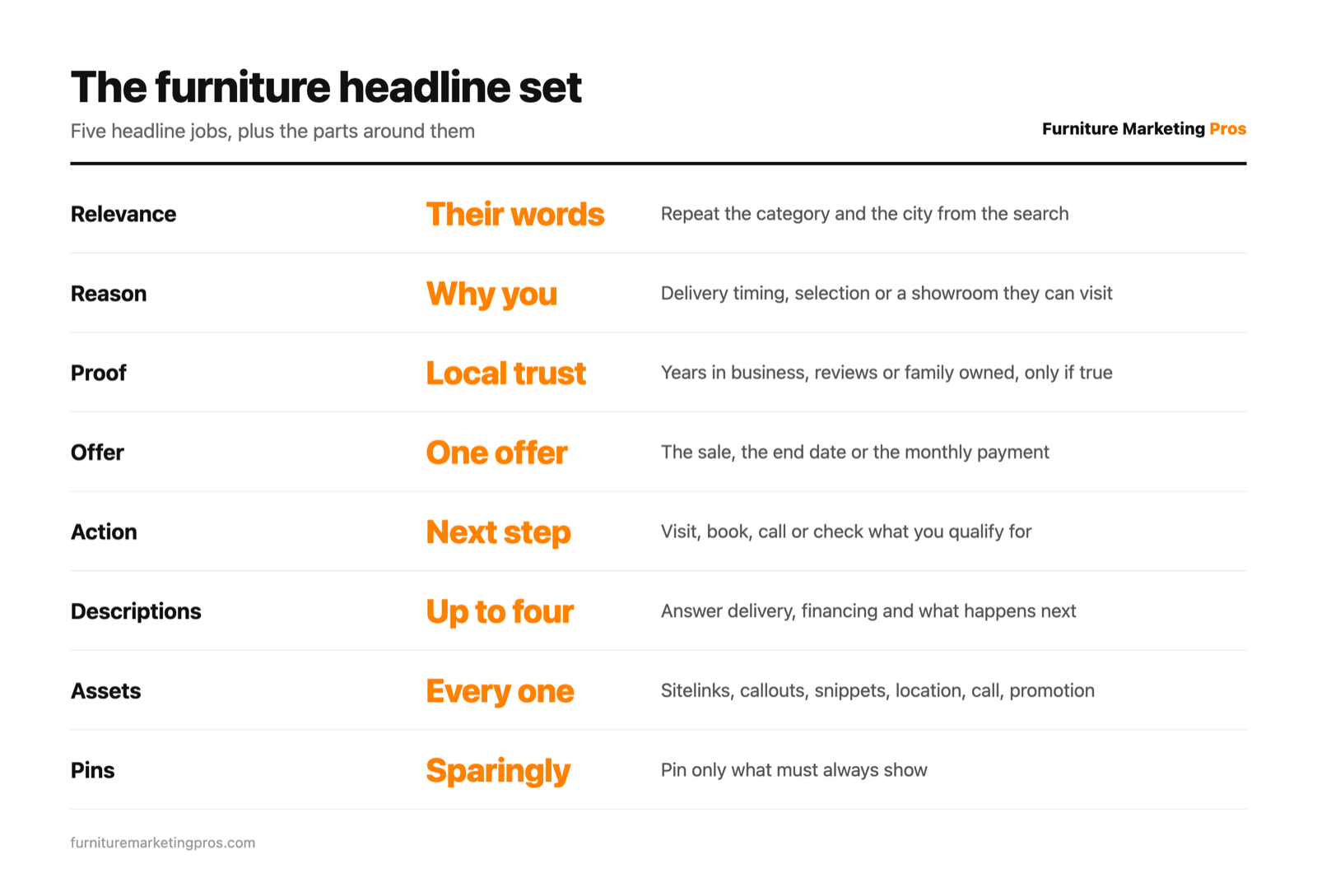
We write the headline set in five groups, so that any three Google picks still make a complete argument. The examples below are for a hypothetical showroom in Raleigh, written to fit inside 30 characters.
Relevance, three or four headlines. The category and the place: "Reclining Sofas in Raleigh", "Sectional Sofas In Stock Now", "Leather Sofas and Sectionals".
Reasons, three or four headlines. Why you instead of a website: "Sit on It in Our Showroom", "Local Delivery and Setup", "Hundreds of Sofas on the Floor" if that is true.
Proof, two or three headlines. "Family Owned Since 1987" with your real year, "Rated by Your Neighbors". Proof only works when it is true and specific, so pull it from your actual reviews and history.
Offer, two or three headlines. "Labor Day Sale Ends Monday", "See Your Monthly Payment". One offer per ad group, current, with the date.
Action, two headlines. "Book a Showroom Visit", "Get Directions to the Store". The action should match what the landing page asks for.
Two rules hold the set together. No two headlines should say the same thing in different words, because that wastes slots Google could have tested. And every headline should be something your salespeople would say out loud. If it would sound strange on the floor, it will read strangely on a phone.
Descriptions that answer the questions shoppers actually have
Headlines win attention. Descriptions win the click from the shopper who is comparing. Furniture shoppers ask the same questions in every market, so the descriptions should answer them before anyone has to ask.
Delivery. When will it arrive and who brings it? "Our own team delivers and sets up every piece, with in stock items arriving fast", if that is true for you.
Financing. Can I afford it this month? Lead with the monthly payment, never with the word credit, and never promise approval. "See what you qualify for in minutes" is honest. "Approved today" is not.
The showroom. Can I see it first? "Sit on every sectional before you buy", plus the hours or the neighborhood.
Reassurance. What if it does not fit? Return policies, comfort guarantees on mattresses, free design help, whatever genuinely reduces the risk.
Write all four descriptions as complete sentences that work alone, at close to the full 90 characters, and make each one carry a different answer. A description that repeats the headline wastes the second chance to persuade.
The words that sell furniture, and the words that do not
After years of reading search terms and conversion reports in furniture accounts, the pattern is consistent. Specific, concrete language wins. Vague, flattering language loses.
Words that work: in stock, delivered, this weekend, in our showroom, monthly payment, the category name, the city name, the brand names you actually carry, and real numbers you can prove, such as years in business or the number of pieces on your floor.
Words that waste space: quality, best selection, affordable luxury, unbeatable prices, one stop shop, and anything an online brand could also say with a straight face. Shoppers skim straight past them because every competitor uses them.
The test is simple. Cover your store name and read the ad. If it could belong to any furniture retailer in America, rewrite it until it could only belong to you. Our earlier post with five tips for writing effective Google ads has more examples of this rewrite in practice.
Offers, seasons and the calendar
Furniture ad copy should change with the calendar, because the shopper's question changes with it. Across the furniture Google Ads accounts we manage, November drew 2.3 times October's impressions on a below median click, while a February click cost about eight times an April click. Copy that ignores the season leaves money on the table at both ends.
Prepare sale copy two weeks before every window: Presidents Day, Memorial Day, the Fourth of July, Labor Day, Black Friday and the December delivery deadline. Write the headlines, schedule the promotion assets, and note in your calendar the day the copy has to come down. Promotion assets let you attach an occasion, a discount and dates, so the offer appears without rewriting every ad. A countdown customizer can show the days remaining in a headline, which is honest urgency because the sale really does end.
Between windows, copy shifts from the deal to the reasons: selection, delivery, the showroom, design help. Tax refund season, from mid February into April, deserves its own message about what a refund buys, a mattress set or a dining table before the family visits.
Assets do half the selling
Assets, which Google used to call extensions, expand your ad with extra lines and links. They make the ad physically larger on the page and give the shopper more reasons to choose you. In furniture accounts we use every relevant one.
Sitelinks to your strongest category pages, your financing page and your showroom page. Callouts for short facts such as local delivery, free design help or financing available. Structured snippets using the Brands, Styles or Types headers to list what you carry. Location assets pulled from a linked Google Business Profile, so the address and distance show. Call assets for shoppers who want to ask before they drive. Price and image assets where the account is eligible.
Ratings and review counts are powerful in copy, but only when they are current and true, which makes your reviews and reputation work part of your advertising. In Shopping and Performance Max, the product title and description in your feed are the ad copy, so a vague title like "Sofa 4471 Grey" loses to "Grey Linen Sofa, 88 Inch, Deep Seat" every time. Our guide to catalog integration for furniture retailers covers how to fix titles at the feed level.
Pinning, policy and the mistakes that cost you
Pin sparingly. Pinning forces a headline into a fixed position, which cuts the combinations Google can test. Pin only what must always show, such as a required financing disclosure or a brand line your manufacturers insist on.
Respect the editorial rules. Google does not allow exclamation marks in headlines and limits excessive capital letters, so "FREE DELIVERY" gets flagged while "Free Delivery" does not. Claims like best or number one should be provable on the landing page, both because unsupported claims risk disapproval and because shoppers do not believe them.
Be careful with brand names. Naming the manufacturers you are authorized to sell is normally fine, but trademark owners can restrict use of their names in ad text, so keep your dealer agreements handy.
Match the page. The most expensive copy mistake is an ad that promises something the landing page does not show. If the ad says Labor Day pricing, the page says it too. Mismatch is one of the most common problems we find when a furniture store's Google Ads campaign is not working.
How to test and judge your ad copy
Google reports a performance label for each headline and description, ranging from low to best, once an asset has gathered enough data. Replace low performers in small batches, keep the best ones, and give new lines a few weeks before judging them.
Judge copy on conversions, not on click through rate alone. A headline that draws curious clicks from people outside your delivery area raises your click through rate and lowers your sales. Track calls, quote requests, direction taps and booked visits as conversions, connect them to sales in a CRM, and read the ad copy through that lens. A line that brings fewer clicks and more appointments is the better line.
Change one thing at a time where you can, and keep a simple log of what changed and when. Six months later, that log is worth more than any best practice list, because it tells you what works for your market. Spring is the cheapest time to test: across our furniture accounts the average April click cost 60 cents against 4.93 dollars in February.
Making the copy part of the work
Ad copy is never finished. It needs a refresh for every sale window, a review every month and a rewrite whenever the store adds a category, a brand or a financing program. That steady attention is a large part of the Google Ads work we do for furniture stores and of day to day paid ads management. If you would like us to read your current ads and tell you honestly which lines are earning their place, book a strategy call.
Key takeaways
- Write each ad for the search that triggers it, grouped by intent, in the shopper's own words.
- Fill all fifteen headlines with relevance, reasons, proof, offer and action, so any three make a complete argument.
- Use descriptions to answer delivery, financing, the showroom and reassurance before anyone asks.
- Replace vague words like quality and best selection with specific, provable facts only your store can claim.
- Refresh copy two weeks before every sale window and take it down the day the offer ends.
- Add every relevant asset and treat feed titles as ad copy in Shopping and Performance Max.
- Judge copy on calls, quotes, booked visits and sales, not click through rate alone.
Frequently asked questions
How many headlines should a furniture store's Google ad have?
Use all fifteen. Google shows up to three at a time and tests combinations, so more distinct headlines give it more to work with. Make sure each one stands alone and says something different.
Should I put prices in my Google ads?
Put in prices or monthly payments when they are a genuine advantage and you can keep them current. A specific payment or a sale price with an end date usually beats vague language like affordable. Stale prices hurt more than none.
Can I use competitor or manufacturer brand names in my ad copy?
Naming the manufacturer brands you are authorized to sell is normally fine, but trademark owners can restrict their names in ad text. Do not use a competitor retailer's name in your copy.
How often should furniture ad copy be updated?
Review it monthly, refresh it two weeks before every sale window, and remove sale copy the day the offer ends. Replace low performing headlines in small batches.
What is the most common mistake in furniture store Google ads?
Generic copy that could belong to any store, sent to a page that does not match the ad. Specific copy written for each ad group and pointed at a matching landing page is the first fix in most accounts we review.