




Every furniture store owner has seen the same thing happen. A sofa video from a brand they have never heard of appears on TikTok, racks up views, and the comments fill with people asking where to buy it. Then the question arrives in the Monday meeting: should we be on TikTok?
Our answer is not the one either camp wants. TikTok is a real advertising platform with genuine reach and a creative format that suits furniture better than most categories. It is also the channel where furniture retailers most often mistake attention for demand, spend a season learning that lesson, and conclude that paid social does not work. Both things are true at once.
This piece is the honest version: what TikTok actually does well for a furniture retailer, where it falls down against a high ticket purchase and a long decision, how the creative and the measurement really work, and how to run a test small enough that being wrong costs you a month rather than a quarter.
The short answer
TikTok is a discovery channel, not a demand capture channel. It is worth testing for a furniture retailer who already has Google Search, Performance Max and Meta running properly, who can produce native vertical video every week, and who can afford to judge results over months rather than days. It is not worth testing for a store that cannot make video, has no tracking beyond a basic pixel, or needs the spend to produce written business this month. Treat it as the top of the funnel, measure it on assisted demand and branded search, and give it a fixed test budget with stop rules written before you start.
What TikTok is genuinely good at for furniture
It shows the product in motion, in a room. Furniture is a category people need to see used. A recliner opening, a sectional being reconfigured, a mattress being pressed, a drawer gliding shut. Vertical video with sound is the right format for that, and TikTok is built entirely around it. Real video of real products in real rooms outperforms catalog renders everywhere, and nowhere more than here.
It reaches people who are not searching. Google finds the shopper who already typed "sectional near me". TikTok reaches the person who has been vaguely unhappy with their living room for a year and has not started looking yet. That is genuine demand creation, and it is the reason the channel is interesting despite everything in the next section.
Delivery day and behind the scenes content performs. The truck arriving, the crew carrying a sectional up a narrow staircase, a customer seeing the room finished, the warehouse at six in the morning, the buyer walking a market and explaining why a piece got picked. This content costs nothing but a phone and it is the kind of thing TikTok distributes well.
Personality travels. A store owner or a salesperson with a face and an opinion builds an audience faster on TikTok than a brand logo ever will. For an independent retailer competing against national brands, that is an advantage you own and they cannot buy.
Production standards are low, on purpose. A polished commercial reads as an advertisement and gets skipped. A phone video with honest lighting and a person talking reads as content. Good news for a store with no studio budget, bad news for one that only owns catalog assets.
The honest limitations for high ticket home goods
The buyer skews younger than your ticket. TikTok's audience is wide now, but the heaviest users are still younger than the median buyer of a 4,000 dollar bedroom set. Renters and first apartments are a real furniture market, and they are not the market for your best margin categories. Match the pieces you feature to the audience you will actually reach.
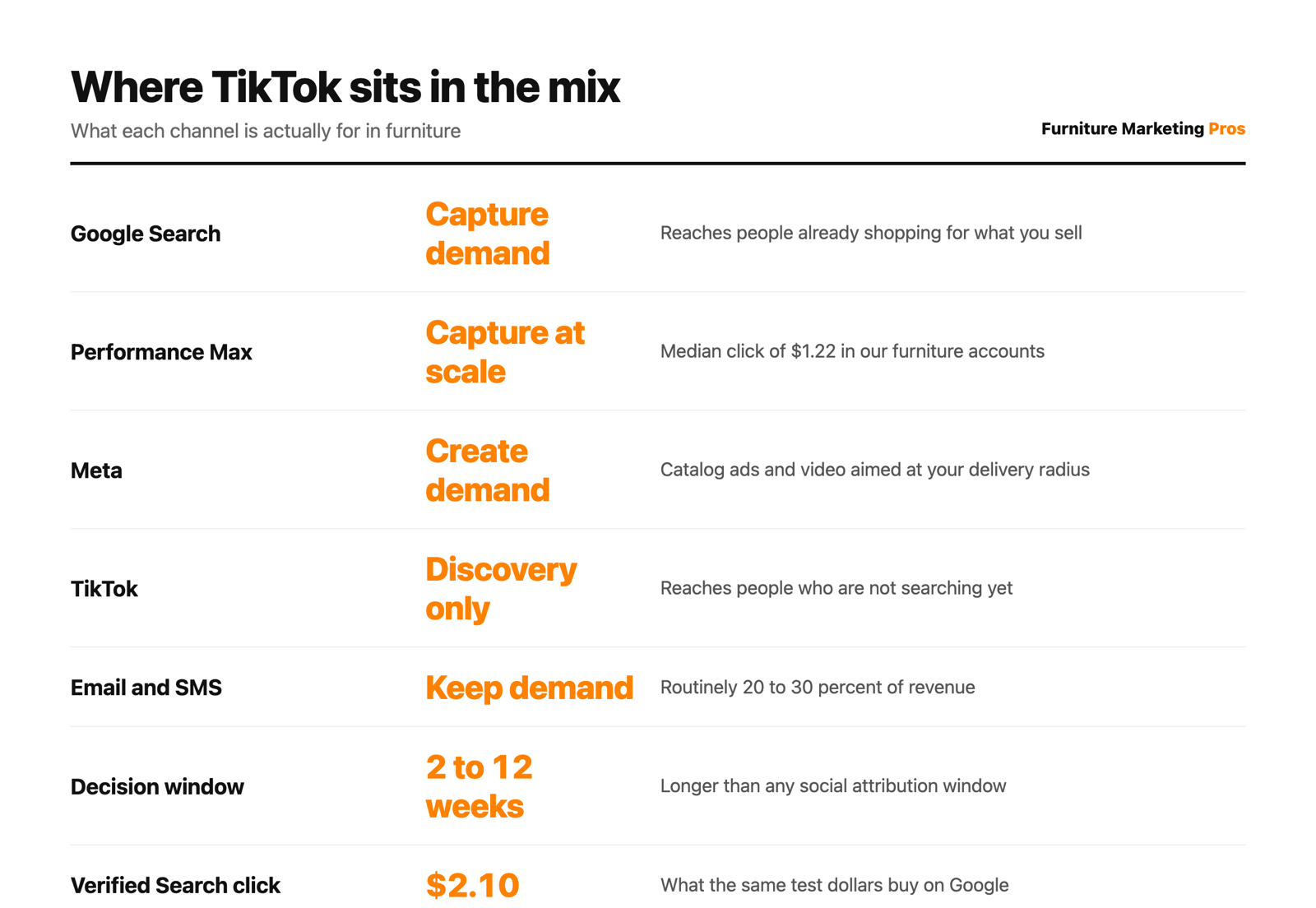
The decision is long and the platform is impatient. Furniture takes two to twelve weeks from first search to purchase. Social attribution windows are much shorter than that, so the person who discovered you on TikTok in March and bought a dining set in May is credited to whatever channel they touched last, usually branded search. TikTok will look worse than it is, and there is no clean fix.
The intent gap is real. Entertainment scrolling and shopping are different states of mind. A viewer laughing at a delivery video is not a buyer in the way that someone typing "queen mattress sale" is. You are paying to create the wish, then paying again on other channels to close it.
Local targeting is coarser than furniture needs. A showroom sells inside a delivery radius. A viral video does not respect that radius, and a large share of the attention you earn will come from places you cannot deliver to. That is fine for brand building and expensive if you are counting it as reach.
The regulatory ground moves. TikTok has spent years in and out of ownership and legal disputes in the United States. That is not a reason to avoid it. It is a reason not to build your customer acquisition on it, which is true of any platform you do not own.
Where TikTok fits next to Google and Meta
Our house position on channels does not change for this one. Google captures demand, Meta creates it, email and SMS keep it, and they should run as a single system. TikTok sits beside Meta on the creation side, earlier and broader, and it earns a place only when the capture side is already working.
The order of operations matters. If your Search campaign is not covering your brand and your best category terms, fix that first, because those are the cheapest sales in your account. The Google Ads playbook covers that structure. If your catalog is not feeding Meta and your retargeting is not excluding buyers, fix that next. Meta ads for furniture stores covers the setup, and retargeting for furniture stores covers the follow through that turns any discovery, TikTok included, into a sale.
Only then does a discovery test make sense. Spending on the top of the funnel while the bottom leaks is how stores end up believing that advertising does not work for them. For the organic side of the same question, our comparison of TikTok and Instagram for furniture stores is worth reading beside this one.
Spark Ads, and why a store should start there
Spark Ads let you put paid budget behind an organic post, either your own or a creator's with their authorization, so the ad keeps the original post's comments, likes and profile link. For a furniture retailer this is the smartest possible entry point, for three reasons.
You already know what works. Post organically for a few weeks, watch which videos hold attention, then put money behind the proven ones instead of guessing with a fresh ad. The format also stays native: a Spark Ad looks like the post it is, social proof included, which is what makes it tolerable to the viewer. And the engagement compounds on the original post rather than on a disposable ad, so your profile grows while the campaign runs.
Pair that with local creators if you can. Someone in your market filming their real room with your furniture in it is worth more than any asset your supplier sends, and creator content can usually be licensed for your own ads too.
What you will and will not be able to measure
Install the TikTok pixel and connect the events API, in the same way and for the same reasons you run the Conversions API on Meta. Browser tracking has been losing signal since Apple's App Tracking Transparency arrived in 2021, and a server connection recovers a meaningful part of it.
Then accept the limits. For a showroom business, TikTok will report video views, clicks, landing page views and whatever online conversions it can see, and it will not see the Saturday afternoon sale written by a customer who first watched your video in March. That is the same blind spot every social platform has, made worse by a shorter attribution window and an audience that is earlier in the journey.
So measure it the way you would measure a billboard with a pixel attached. Watch branded search and direct traffic during the test and after it, watch new visitors and email captures rather than immediate purchases, and ask at the counter how people first heard of you. Then retarget everything TikTok sends you on the channels that do convert.
How to run a real test without gambling the season
Here is the shape we would use for a store that has the fundamentals in place.
Set a fixed budget you can lose. Our practical starting point is a small daily spend held steady for six to eight weeks, funded from your experimental budget rather than out of Search or Meta. Furniture buying cycles run two to twelve weeks, so a two week test tells you nothing.
Run four to six creatives, not one. Delivery day, a product in motion, a customer reaction, an owner explaining a buying decision, a room transformation. Refresh them every two weeks, because creative fatigue arrives faster on TikTok than anywhere else.
Send traffic to a page built for the visitor. Not the homepage. A category or collection page with the exact piece from the video, dimensions, delivery information, financing shown as a monthly payment, and one easy way to ask a question.
Capture the address. A visitor from TikTok who leaves an email is worth far more than one who does not, because you can then reach them for the whole twelve weeks it might take them to decide.
Write the stop rules before you start. Stop or rebuild if six weeks of spend produces no measurable lift in branded search or direct traffic, if the traffic does not stay on site long enough to read a product page, if almost none of it comes from inside your delivery radius, or if you cannot sustain the weekly creative output. That last one ends more TikTok programs than performance does.
Who should test it, and who should not
Test it if Search, Performance Max and Meta are running properly, someone on your team enjoys making video, your categories appeal to younger households, and you can judge a channel on contribution rather than last click. Test it if you are building a brand beyond one showroom, because the reach is real.
Skip it if your Google account is not covering your brand terms, if your product feed is a mess, if nobody on staff will film consistently, or if this quarter's spend has to produce written business. Skip it also if the only creative you can supply is the manufacturer's catalog photography, because that content does not survive on this platform. Those are not permanent verdicts, they are a sequence, and most stores have a more profitable fix waiting in front of them. For the broader question of what paid social should be doing for a furniture store, our social media marketing work starts from the same position.
Where this fits with the rest of your advertising
A discovery test is only useful when the rest of the system can catch what it creates, which is why we run channel tests inside a plan rather than as experiments on the side. That is the job of paid ads management: decide what each channel is responsible for, fund them in the right order, and judge each one on the thing it can actually do. If you want a straight answer about whether TikTok belongs in your mix this year, book a strategy call and we will look at what your current channels are leaving on the table first.
Key takeaways
- TikTok creates demand, it does not capture it, so it belongs after Search, Performance Max, Meta and retargeting are working.
- The format suits furniture, because products in motion and real rooms are exactly what the platform distributes well.
- The audience skews younger than your best margin categories and the reach ignores your delivery radius, so expect waste.
- A two to twelve week furniture decision outlasts social attribution windows, which means TikTok will always look worse than it is.
- Start with Spark Ads behind organic posts that already earned attention, rather than guessing with fresh creative.
- Measure branded search, direct traffic, new visitors and email captures, and retarget every visitor on channels that convert.
- Set a fixed test budget, run six to eight weeks, refresh creative every two weeks, and write your stop rules in advance.
Frequently asked questions
Do furniture stores actually sell furniture on TikTok?
Some do, mostly online brands with lower price points and strong creator content. For a showroom retailer, the realistic outcome is discovery and brand awareness that shows up later as branded searches, site visits and showroom traffic, not as checkouts inside the app.
How much should a furniture store budget for a TikTok test?
Enough to run consistently for six to eight weeks with fresh creative, funded from an experimental budget rather than taken out of campaigns that are already producing sales. If the amount you can commit would meaningfully damage your Search or Meta results, the test can wait.
Is TikTok cheaper than Meta or Google for furniture?
Impressions are often cheap, which is not the same as sales being cheap. Judge it against what the same money buys elsewhere: across the furniture accounts we manage, the median click costs 2.10 dollars on Search and 1.22 dollars on Performance Max, and those clicks come from people already looking for furniture.
What kind of videos should a furniture store post?
Delivery days, products in motion, real customer rooms, honest opinions from your buyer or owner, and quick answers to the questions people ask on the floor. Film on a phone, keep it vertical, and make the first two seconds worth staying for.
Can I just reuse my Instagram Reels on TikTok?
Often yes, and it is a sensible way to start, as long as the video does not carry another platform's watermark. Watch the results separately though, because the same clip frequently performs very differently on each platform and the audiences are not the same people.