




Ask a furniture store owner how they advertise on Facebook and Instagram and you will usually hear the same sentence. We put a little money behind the posts that do well. It is the most common paid social strategy in this industry, and it is the main reason so many owners have decided that social advertising does not work for furniture.
I understand why it happens. The button is right there under the post, it takes eleven seconds, it produces a satisfying little graph, and nobody has to learn an ad platform on a Saturday when two delivery trucks are late. Boosting feels like advertising.
It is not. Boosting is a single button that buys attention for a piece of content, and attention is not the same thing as a sofa sold. This article covers what the button actually does, what it quietly takes away from you, what to run instead, and the handful of situations where boosting is genuinely the right call.
The short answer
Boosting a post creates an engagement objective ad with almost no control over your objective, your audience exclusions, your placements or your conversion tracking. You are paying Meta to find people who will react to a photo, and then judging the money on reactions. A real campaign starts with a business outcome you can count, a clean conversion signal from the pixel and the Conversions API, audiences you build and exclude on purpose, and enough creative for the system to test. Same platform, same budget, a completely different question asked of it.
What the boost button actually does
When you boost, Meta creates an ad with an engagement objective. Its job is to find the cheapest possible reactions, comments and shares inside a loosely defined audience. It is very good at that job. Those are real people and those are real likes.
The trouble is that the cheapest engagement on Facebook and Instagram comes from the people most willing to tap on anything, and the person who taps a heart on a sectional at eleven at night is not reliably the person who drives forty minutes on Sunday to sit on it. The system was never asked to find that second person, so it did not look for them.
Everything else follows from that. The reporting you see is reach, engagements and cost per engagement, so those become the numbers you judge the spend on. Six months later the conclusion is that Facebook does not sell furniture, when what actually happened is that nobody ever asked Facebook to sell furniture.
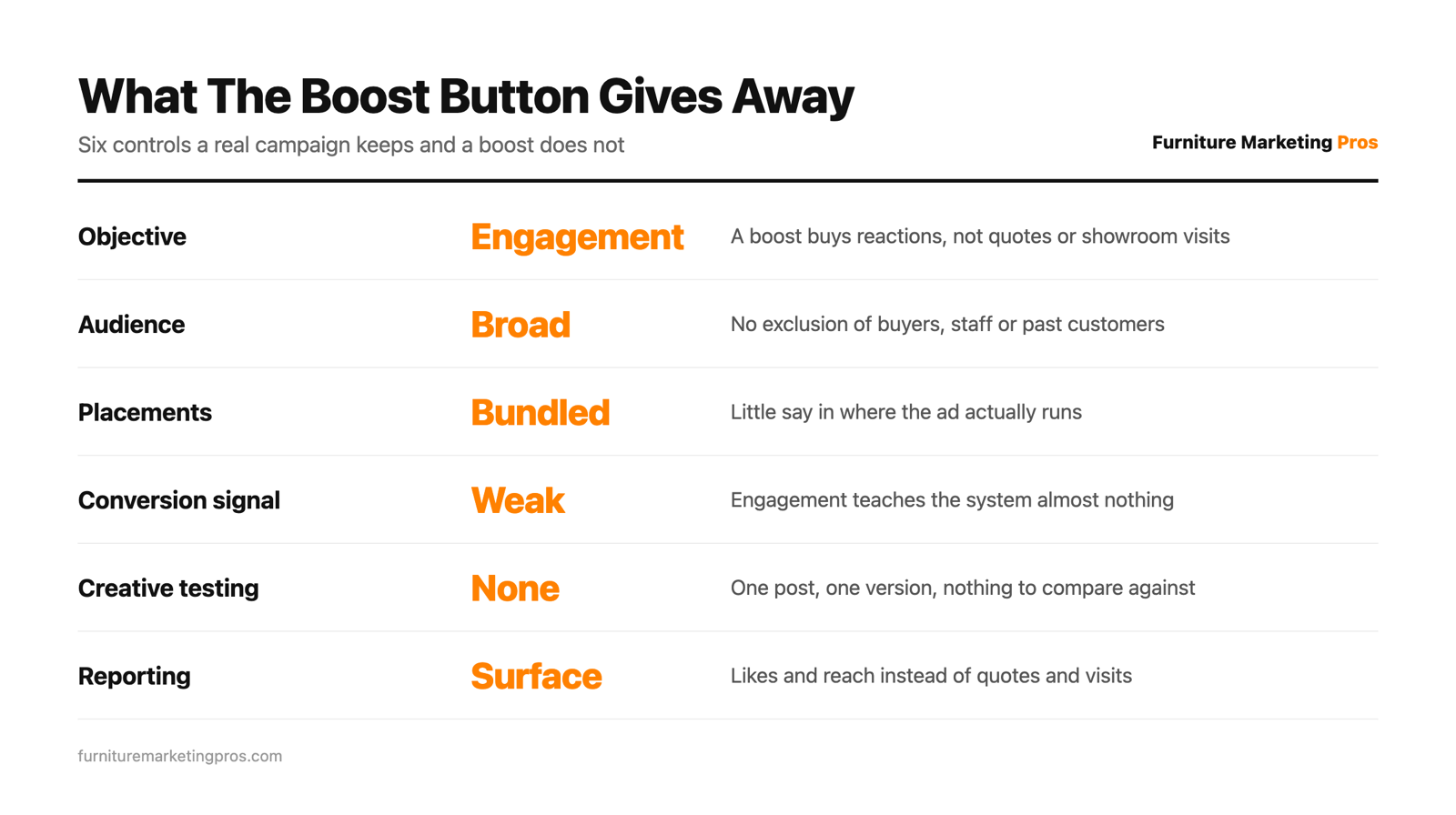
The six controls you hand over
The objective. This is the big one. On a proper campaign you choose what you are buying: a lead, a message, a booked appointment, a landing page view, a purchase. A boost buys engagement. Everything downstream of that choice changes.
Audience and exclusions. A campaign lets you exclude the people you should never pay to reach again. Customers who bought last week. Your own staff. The list of people who already requested a quote. Boosts have no serious exclusion layer, which is how stores end up advertising a dining set to the family whose dining set is already on the truck.
Placements. A campaign lets you decide where the ad runs and switch off the placements that produce accidental clicks rather than shoppers. In the furniture accounts we manage we turn off placements outside the core Facebook and Instagram surfaces for exactly that reason. A boost bundles it all together.
Conversion tracking. A campaign can optimize toward a pixel event: a quote request, an appointment, an add to cart. It can be fed by the Conversions API, which sends events from your server rather than from the browser. That matters more than it used to, because since Apple's App Tracking Transparency arrived in 2021 the browser pixel alone misses a large share of iPhone users. A boost is not built for any of this.
Creative testing. A campaign runs several images, several videos and several pieces of copy, and the system moves budget toward what works. A boost runs one post, which means you learn nothing you can use next month.
Reporting that connects to money. A campaign can be read against quote requests, conversations started, appointments booked and sales matched back in your CRM. A boost reports on the post.
Meta's automation is genuinely good now, but it is good in proportion to what you feed it. Our companion piece on Meta AI ads and Advantage+ campaigns for furniture stores goes deep on that side. The short version is that the automation cannot optimize toward an outcome you never gave it.
Why the gap hurts furniture more than most categories
Every retailer loses something by boosting. Furniture loses more, for four specific reasons.
The decision takes two to twelve weeks. Mattresses sit at the short end, a full living room at the long end. A boost is a one night stand with a shopper who needs a six week relationship. There is no follow up, no sequence, no second message that answers the objection the first one raised.
There is no memory. The whole point of paid social in a long cycle category is that today's viewers become next month's audience. A properly structured account builds video viewers, page engagers, site visitors and product viewers into audiences you can come back to. That is the entire subject of retargeting for furniture stores, and boosting contributes almost nothing to it.
Two people decide. The person who saves the sectional at lunch is rarely the only vote. Campaigns can reach a household through broader audiences, retargeting and email capture. A boost reaches one thumb.
The sale usually happens in your showroom. Which means the whole job of the ad is to produce a visit, a call, a message or a quote request, and those are precisely the outcomes a boost cannot be optimized for. If most of your revenue is written on the floor, your ads need to be judged on floor traffic, and what social media actually does for a furniture store is a fair question to keep asking of every dollar.
The fix, in the order we actually do it
You do not need a bigger budget to stop wasting one. You need these five things in this sequence.
One. Decide the outcome you can count. For most single showrooms that is a messaging conversation, a quote or appointment request, or a qualified phone call. If you sell enough online, it is a purchase. Write the outcome down before you open Ads Manager, because that choice decides everything else.
Two. Install the signal. Pixel and Conversions API, both, before a single ad runs. Then make sure the events you care about actually fire: form submitted, chat started, call placed, appointment booked. An account optimizing toward a broken event is worse than no account, because it spends confidently in the wrong direction.
Three. Build the audiences and the exclusions on purpose. Your customer list uploaded as a match audience. Your site visitors, split by what they looked at. Your buyers, excluded from acquisition campaigns the day the order lands.
Four. Make creative in batches, not one at a time. The system needs variations to test. Film six short videos in one afternoon on the showroom floor: someone reclining the recliner, the sleeper pulling out, the drawer glide, the fabric up close, the delivery team carrying a piece in, a customer saying why they chose you. Add the offer or the financing to the first frame. That is a month of creative in ninety minutes, and it is the single highest return use of a slow Tuesday.
Five. Separate prospecting from retargeting. Two campaigns, two budgets, so the cold campaign cannot eat the warm one. Our Facebook ad strategies for furniture stores piece walks through the structure.
Then read it weekly against business numbers, not platform numbers.
When a boost is actually fine
Boosting is a tool, not a sin. It earns its place in a few situations.
A dated event. A tent sale, a designer evening, a clearance weekend. You want maximum local reach for six days and you are not trying to build an audience.
A post that is already performing organically. If a piece of content is doing unusual numbers with your own followers, putting money behind it to extend that reach locally is reasonable. You are amplifying a proven hook, not hoping.
Cheap hook testing. Boost three pieces of content for a small amount each to see which idea holds attention, then build the winner into a real campaign with a real objective. This is the smartest use of the button.
Community moments. An anniversary, a local sponsorship, a team photo, a charity drive. These build the goodwill that makes a local showroom feel local, and engagement is a fair measure for them.
The rule we use in the accounts we manage is simple. Boosting can have the small share of the budget reserved for reach and brand presence. It cannot have the share responsible for producing customers. And where possible, run even those boosts from Ads Manager as a proper engagement or reach campaign, so you keep your targeting, your placements and your exclusions.
How to tell whether your paid social is working
Stop reading the like count. Ask four questions every month.
How many conversations, quote requests and appointment bookings came from paid social? How many of those turned into a showroom visit you can verify? What did each of those cost? And how many closed, according to your CRM rather than according to the platform?
If you cannot answer those, the problem is not the ads. It is that nothing connects the ad to the sale. Capture the email and the phone number on every interaction, put them into a system, and let the ads, the email and SMS follow up and the sales floor all read from the same record. That is when paid social stops being a mystery.
Where this fits with the rest of your marketing
Organic content builds the reason to follow you between sales, and that is its own discipline, covered under social media marketing for furniture brands. Paid campaigns are what turn that content into traffic, conversations and visits you can count, and running them properly across Meta and Google is what paid ads management for furniture stores means day to day. If you want a second opinion on what your current spend is actually producing, book a strategy call and we will look at the account with you.
Key takeaways
- Boosting creates an engagement objective ad, so it optimizes for reactions rather than for quotes, conversations or showroom visits.
- You give up six controls when you boost: objective, audience exclusions, placements, conversion tracking, creative testing and useful reporting.
- Furniture loses the most from boosting because the decision takes two to twelve weeks and boosts build no audience to follow up with.
- Install the pixel and the Conversions API, pick one countable outcome, build exclusions, and film creative in batches before you spend more.
- Boost dated events, proven organic posts, cheap hook tests and community moments, and never let boosting carry the budget that has to produce customers.
- Judge paid social on conversations, appointments and closed sales in your CRM, not on the like count under the post.
Frequently asked questions
Is boosting a post the same as running a Facebook ad?
No. Boosting creates an engagement objective ad with very little control over audience exclusions, placements and conversion tracking. A campaign built in Ads Manager lets you choose the outcome you are buying and optimize toward it, which is what changes the result.
Why do my boosted posts get lots of likes but no customers?
Because likes are exactly what you asked for. The engagement objective finds people most likely to react, not people most likely to visit a showroom or request a quote. Change the objective and the audience changes with it.
How much should a furniture store spend on paid social instead?
Enough to run a prospecting campaign and a retargeting campaign with separate budgets and still exit the learning phase. Start with what you can sustain for ninety days rather than a burst, and raise it two weeks ahead of each sale window.
Do I need the Conversions API if I only have a showroom?
Yes, and arguably more than an online seller does. Since Apple's tracking changes in 2021 the browser pixel misses a large share of iPhone users, and a showroom already has fewer online events to learn from. Server side events protect the signal you do have.
Should I ever boost again?
Yes, for dated events, for posts already performing organically, for cheap testing of a creative hook, and for community moments. Keep it to the small brand and reach portion of the budget, and run the rest as real campaigns.