




Most furniture stores that try influencer marketing do it the same way. Someone on the team finds a local account with a big following, sends over a free accent chair, the creator posts a story that disappears in a day, and nobody can say whether a single person walked into the showroom because of it. The store decides influencers do not work and moves on.
The problem is rarely the idea. Furniture is a visual, emotional, considered purchase, and a real person sitting on your sofa in a real room is exactly the kind of proof shoppers look for during the weeks they spend researching. The problem is that the program was built like a favor instead of like a campaign, with no brief, no rights, no ad spend behind it and no way to measure it.
Here is how to run it properly: who to work with, how to pay without guessing, what to put in writing, how creator content plugs into your Meta and TikTok ads, and how to tell whether it brought people through the door.
The short answer
For a furniture or mattress store, influencer marketing works best as a source of trusted video that you then run as ads. Work with local and regional home creators whose followers can actually drive to your showroom, pay for clear deliverables and usage rights rather than for follower counts, and get the agreement in writing before anyone films. Run the best content as Meta partnership ads or TikTok Spark Ads so it reaches people beyond the creator's own audience. Measure with unique codes, tracked links, a showroom question at the counter and a CRM, and skip any creator who will not disclose the partnership or share real audience data.
Why influencer marketing is different for furniture
The purchase is considered, typically two to twelve weeks from the first search to the sale, mattresses at the short end and full rooms at the long end. One creator post almost never closes a sale. What it does is put your store on the shortlist early and give shoppers something to believe while they compare.
For a showroom retailer the sale also happens in person. The shopper sees the video, visits your website twice, then drives over on a Saturday. Unless you plan for that path, it is invisible.
And the product is big. A creator cannot unbox a sectional on camera in thirty seconds. The content that works is a room: the piece in a real home or styled in your showroom, someone sitting on it, the fabric close up, the delivery team carrying it in. Real video of real products in real rooms beats catalog renders, and that is the single best reason to work with creators at all.
Local and regional creators versus national names
For a store with one or a few showrooms, the right creator is almost always local or regional.
A national home account looks impressive, but most of its followers live hundreds of miles from your door. A local creator with a fraction of the following, whose audience is within driving distance, can send more real visits.
Local lifestyle and family creators. People who post about their town, their home and their weekends. Their followers trust them on where to shop locally.
Regional home and design accounts. Creators who cover renovations, room makeovers and decor in your metro area. They speak to the people already planning a purchase.
National creators, sparingly. They make sense for an online store that ships nationwide or for a brand building awareness at scale. For a showroom, they are usually the last place to spend.
Ask every creator for an audience breakdown by city and region from their own analytics. If most followers are not within reach of your showrooms, the account is the wrong fit regardless of its size. Our earlier piece on vetting a creator before you send them a sofa goes deeper on the checks.
Home and interior creators, and the customers you already have
Two groups deserve a place in the program beyond lifestyle creators.
Interior designers and home stylists with an audience. They bring credibility on fit, scale and fabric, and their content naturally shows full rooms. Many already buy from local stores for their clients, so the relationship can outlast a single campaign.
Your own customers. A delighted customer filming their new dining room on a phone is often more persuasive than a polished creator post, because it is obviously real. Ask for permission, offer a thank you, and treat it with the same rights paperwork as a paid creator. We covered how to collect this kind of material in turning customer photos into sales, and the wider local approach in local creators, designers and real homes.
Gifting versus paid: what to pay without guessing
We do not publish creator rates, because there is no honest single number. Rates vary by market, audience, format and usage. What you can do is structure the deal so you know exactly what you are buying.
Gifting. You send or deliver a piece, and the creator posts if they choose. It costs only the product, but you have little control over timing or content, and usually no right to run it as an ad. It suits a first conversation, not a campaign.
Product plus a fee. The creator receives the piece and a flat fee for agreed deliverables. This is the most common structure for a furniture store, because the product is valuable and the fee secures the dates, the formats and the review step.
Fee plus usage rights. You pay an additional amount for the right to run the content as ads for a set period. This is where the real value sits, because the content then works for months instead of a day.
To set your own ceiling, work backwards from your numbers, not from what the creator asks. Take your average ticket and your margin on it, decide how many new sales the deal would need to drive to pay for itself, and ask whether that is realistic for this audience. If it is not, the deal is too expensive, however good the account looks.
One rule applies to every structure. A free piece of furniture is a material connection, and the FTC's guidance for influencers says to disclose any relationship where the creator got anything of value, including free products.
How to brief a creator
A creator without a brief makes content for their audience. A creator with a good brief makes content that also sells your furniture. Keep it to one page.
The goal. Showroom visits, a specific sale event, or awareness of a new collection. One goal, not three.
The product and the room. Which pieces, styled how, filmed where: in their home after delivery or in your showroom.
The must say points. Two or three at most: the sale and its end date, financing shown as a monthly payment, delivery timing, the showroom location.
The must avoid points. No price promises you cannot honor, no claims about approval for financing, no competitor mentions.
The formats and dates. Reels, stories, TikTok videos, a post. When each goes live, and when you see drafts.
The call to action. Visit the showroom, use the code, tap the link. One action.
Then leave room for the creator's voice. A script read word for word performs like an ad.
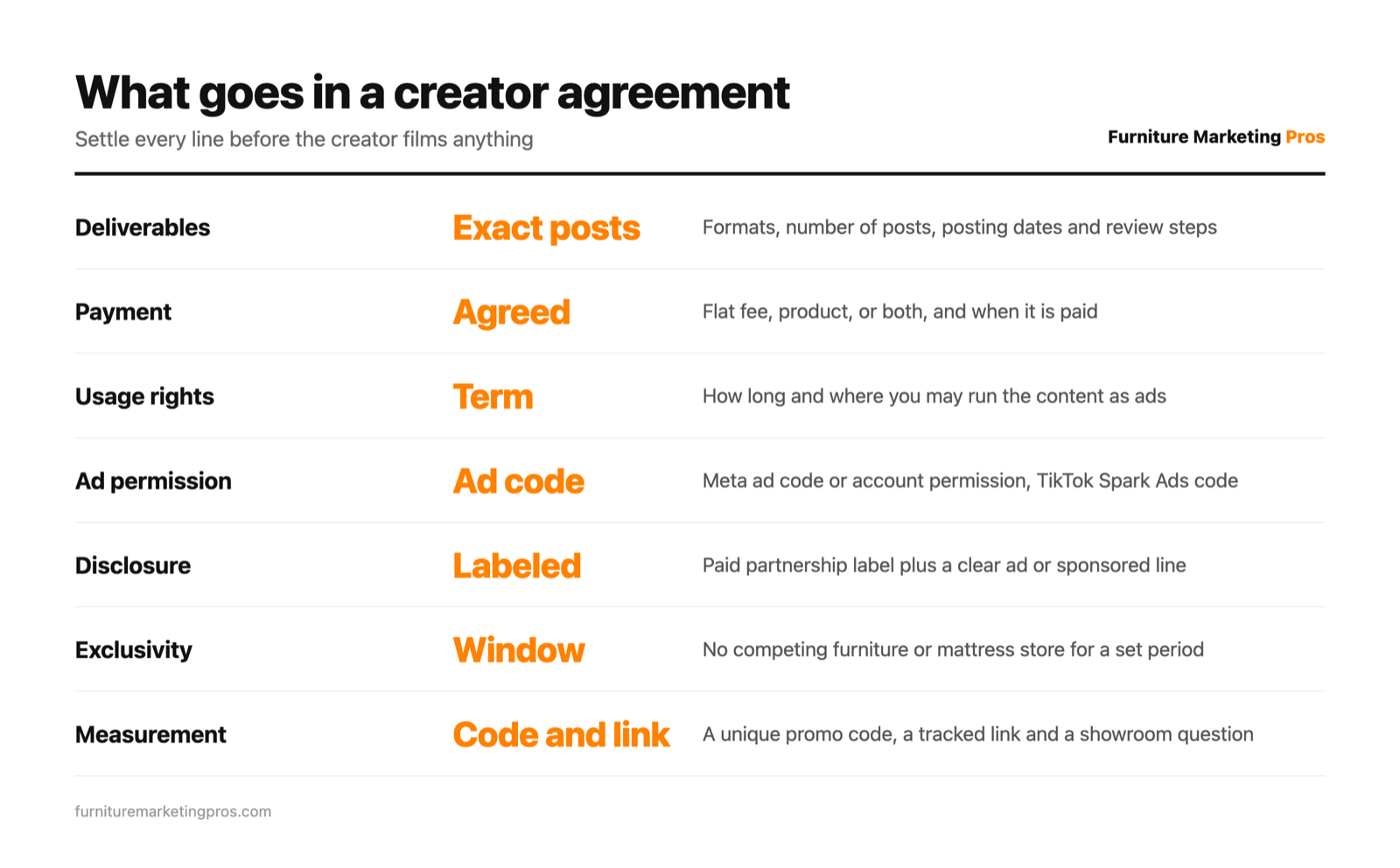
Usage rights, disclosure and the agreement
Every program needs a short written agreement, even with a creator you know, covering the seven lines above.
Usage rights define how long and where you may use the content: organic posts on your own accounts, your website, email, and paid ads. Ad usage is the right that matters most, so name the term and the channels plainly.
Disclosure protects you as much as the creator. The FTC's guidance says the disclosure should sit with the endorsement itself, be hard to miss, and use clear words such as ad or sponsored rather than vague tags. It also says not to assume a platform's built in disclosure tool is enough on its own, so ask for the paid partnership label and a clear line in the caption or on screen.
Partnership ads: where creator content meets Meta ads
This is the step that turns a single post into a campaign. What the industry calls whitelisting, Meta calls partnership ads. Its Business Help Center notes that branded content ads are now called partnership ads, and they run with both your identity and the creator's, so the ad appears with the creator's name and face rather than only your logo.
Meta documents two kinds of permission. With content level permission, the creator lets you promote a specific post, story or reel, either by sharing a partnership ad code or by tagging you with the paid partnership label and turning on the setting that allows the brand partner to boost. With account level permission, a trusted partner can run ads from the creator's handle without pre existing content and turn tagged organic posts into partnership ads. Meta's Help Center also states that an ad code can be used by up to two advertisers at a time, that you can edit the content for the ad while the original post stays the same, and that creators can revoke permissions at any time, which pauses running ads.
On TikTok the equivalent is Spark Ads, which run an organic post as an ad. TikTok's Business Help Center explains that the creator generates a video code in the post's ad settings and chooses an authorization duration of 7, 30, 60 or 365 days. It also notes that the caption cannot be edited once the post is authorized, so agree the caption first.
Inside your ad account, creator content is simply another creative, and on Meta the creative is the targeting. Feed partnership ads into the structure described in our guide to Meta AI ads for furniture stores, and use the strongest videos in retargeting for people who viewed a product and did not buy. Match the duration of the permission to your usage rights so nothing expires mid campaign.
Measuring showroom lift and promo codes
You will not capture every sale a creator influences, so build several measures and read them together.
A unique promo code per creator. Easy to track online and at the counter. It undercounts, because many showroom shoppers forget the code, so treat it as a floor.
A tracked link per creator. Tagged links show visits, product views and form fills from each creator's audience in your analytics.
The showroom question. Train the team to ask every new customer how they heard about the store, with the creators' names on the list, and record the answer in your CRM against the sale.
Showroom traffic around the posts. Compare walk ins, appointment bookings and Google Business Profile direction requests in the weeks around a campaign with the weeks before. Avoid launching inside a big sale event if you want a clean read.
Partnership ad results. Judge them on inquiries, booked appointments, verified visits and sales, not likes.
Our guide to measuring digital marketing success covers the reporting that makes these numbers useful.
Red flags to skip
No audience data. A creator who will not share follower locations and real engagement from their own analytics is asking you to buy blind.
Sudden follower jumps and generic comments. Signs of purchased followers or engagement.
Refusing to disclose. A creator who wants to hide the partnership puts your store at risk.
No usage rights on offer. Content you cannot run as an ad is worth far less.
Too many competing deals. A feed full of furniture and mattress brands dilutes every one of them.
Audiences outside your area. For a showroom, a large following elsewhere is reach you cannot convert.
Pay for a post with no plan behind it. One post, no ads, no tracking. This is the version that fails.
Where Furniture Marketing Pros fits
Creators make the content. The results come from what happens next: the partnership ads, the retargeting, the tracking, the CRM that ties a creator's audience to a showroom visit and a ticket. That is the side we run for furniture and mattress stores as part of our paid ads management, working alongside the creators you choose. If you want help planning a creator program that you can actually measure, book a strategy call and we will map it with you.
Key takeaways
- Influencer marketing works for furniture as a source of trusted video that you then run as paid ads.
- Local and regional home creators whose followers can drive to your showroom usually beat national names.
- Pay for deliverables and usage rights, and set your ceiling from your own ticket and margin, not from follower counts.
- Put deliverables, payment, usage rights, ad permissions, disclosure and exclusivity in a written agreement.
- Meta partnership ads and TikTok Spark Ads turn one creator post into a campaign, with permissions the creator controls.
- Measure with codes, tracked links, a showroom question and a CRM, and read them together.
Frequently asked questions
How much should a furniture store pay an influencer?
There is no honest single rate, because pricing depends on market, audience, format and usage rights. Work backwards from your average ticket and margin to decide how many sales the deal must drive, and pay for clear deliverables and ad usage rather than follower count.
Is gifting furniture to influencers enough?
Gifting can open a relationship, but it gives you little control over timing or content and usually no right to run it as an ad. A free product still counts as a material connection, so the creator must disclose it.
What are Meta partnership ads?
They are ads that run with both your identity and a creator's, formerly called branded content ads. The creator grants permission through a partnership ad code, the paid partnership label with boosting allowed, or account level permission, and can revoke it at any time.
Should a furniture store work with local or national influencers?
For a showroom retailer, local and regional creators are usually the better fit, because their followers can actually visit. National creators make more sense for online stores that ship nationwide.
How do I measure whether an influencer campaign worked?
Give each creator a unique promo code and a tracked link, ask every new customer how they heard about you and record it in your CRM, and compare showroom traffic around the campaign with the weeks before. Judge partnership ads on inquiries, visits and sales.