




An independent mattress retailer is in an unusual fight. You sell a product that people research online and almost always want to lie on before they buy, against national brands that sell direct, ship in a box, and can afford to bid on every mattress keyword in the country all year long.
Owners react to that in one of two ways. Some stop advertising online entirely and put the money back into radio and mail. Others try to fight the national brands on their own ground, bidding on broad category terms and losing steadily.
Both are the wrong move. The national brands are strong nationally and thin locally, and that gap is where a showroom wins. This is the paid media plan we build for mattress retailers, in the order we build it.
The short answer
Do not compete with national online brands for national terms. Compete for your own market, where you can be bought today, slept on today and delivered tomorrow. That means local search dominance inside a realistic radius, Performance Max fed by a clean feed with store visits counted as conversions, creative that leads with the trial, the delivery and the monthly payment, careful conquesting of brand searches, real video of real people on real beds, and retargeting sized to a mattress cycle rather than a sofa cycle.
What you are actually competing against
The national brands play a volume game. They advertise everywhere, sell one product line at a few price points, and accept a return rate as the cost of never having a showroom. Their whole model depends on removing the reason to visit a store.
You cannot outspend that and you do not need to. What you have to do is show up in the moments their model cannot serve, and there are four of them.
Somebody needs a mattress this week because the guest room is a mess and family arrives Friday. Somebody has a bad back and wants to lie on three beds before spending real money. Somebody wants the old mattress taken away and the new one set up. Somebody needs to spread it over payments and talk to a person about it.
Every one of those is a local search, a local ad and a local close. The plan below is about owning them.
Own the searches only you can win
Start where the auction is thinnest and the intent is highest.
Near me and city terms. "Mattress store near me", "mattress stores in Leesburg", "king mattress sale near me", "mattress store open now". Exact and phrase match, tight ad groups, ad copy that names your city and your delivery area. These are the terms where a national brand either does not compete or competes badly, because their ad cannot promise a showroom five minutes away.
Brand plus local. People search "Tempur Pedic dealer near me" and "Stearns and Foster store" constantly. If you carry the line, bid on it. This is one of the highest converting search groups in mattress retail and one of the most commonly missed, usually because a shared negative keyword list is blocking the brands the store actually sells.
Problem searches. Back pain, hot sleepers, a partner who moves, a bad hip. Mattress shoppers search by problem rather than by product, which is the entire argument of our piece on condition based mattress searches. Paid search can occupy those terms while the organic pages are still climbing.
Your own brand. Cheapest clicks in the account, and the terms the national brands and the local competition will happily bid on if you leave them alone.
Set location targeting to the radius you genuinely serve and deliver to, not the whole state, and bid up in the zip codes your sales data says actually buy. Then check the search terms report every week and add negatives, because "mattress" on broad match will find you people looking for air mattresses, crib mattresses, pet beds and mattress disposal.
What a click costs and when to spend
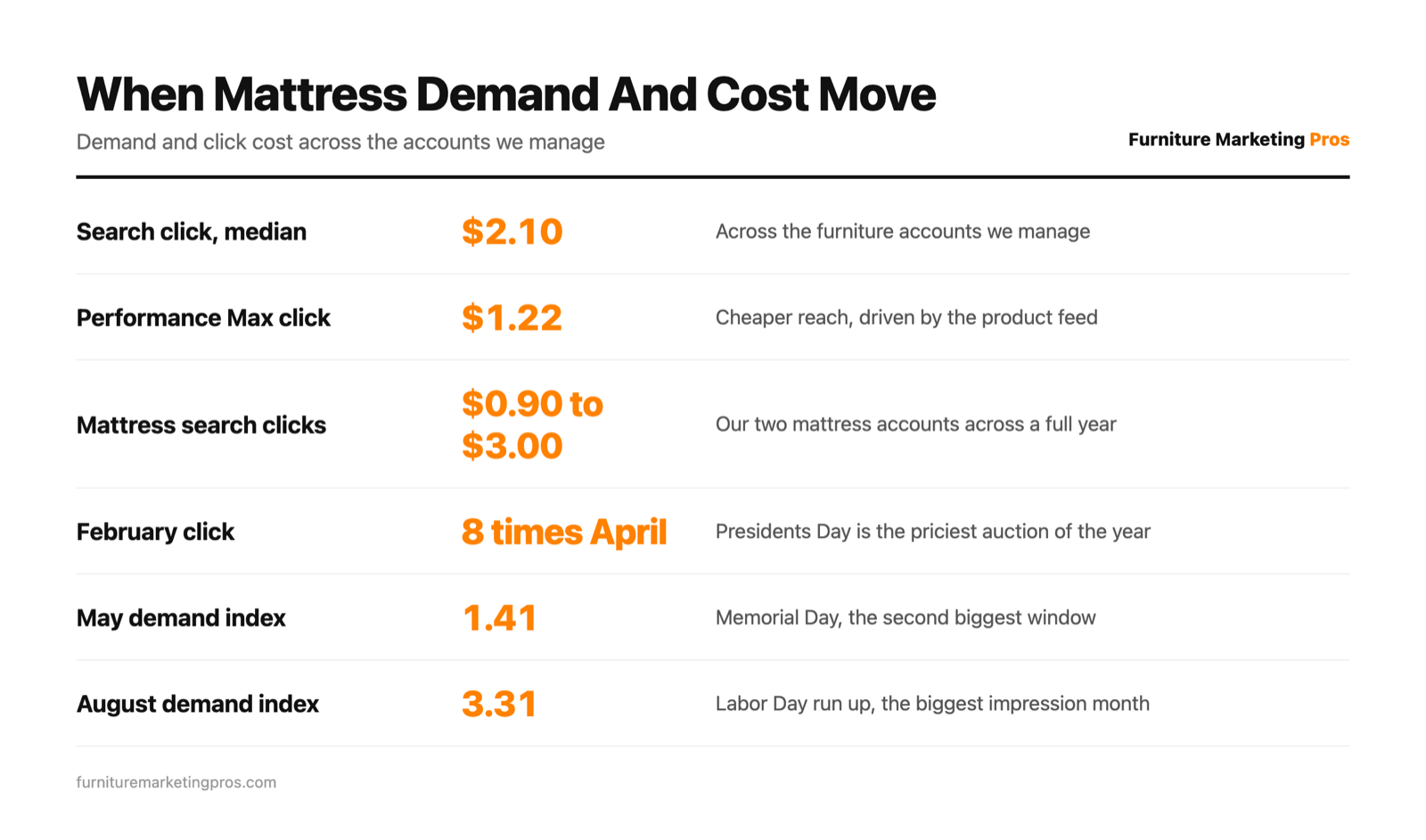
Across the furniture Google Ads accounts we manage, the median Search click runs about $2.10 and the median Performance Max click about $1.22. In our two mattress accounts specifically, Search clicks ran roughly $0.90 to $3.00 through the year, and at that sample size we do not see a reliable seasonal curve in mattress alone. We would rather tell you that than draw a chart out of two accounts.
The broader account data does show a clear calendar, and mattress promotions ride the same holidays. August was the biggest impression month in the year we measured, at 3.31 times the median month, on the run up to Labor Day. May ran at 1.41 as Memorial Day arrived. February was the opposite: the lowest demand of the year and the most expensive click, roughly eight times what a click cost in April, because every retailer in the country crowds the Presidents Day auction at once.
The practical rule that falls out of that is to raise budgets about two weeks before each window so campaigns have learned something by the time demand arrives, and to ease back in the quiet weeks rather than spending flat all year. The Google Ads playbook for furniture stores covers the campaign structure this pacing sits inside.
Performance Max, the feed and store visits
Performance Max should usually be the largest campaign in a mattress account, and it lives or dies on two inputs.
The first is the feed. Every model, every size, every comfort level, with real titles, correct availability and prices that match the page. A mattress catalog is small compared to a furniture catalog, which means there is no excuse for it being messy.
The second is conversion data that reflects how you actually sell. Online purchases if you sell online. Otherwise appointment requests, financing applications, qualified phone calls and direction requests, each with a value attached so the system understands that a call is worth more than a page view. Google Ads also offers store visits conversions for accounts with a linked and verified Google Business Profile and enough volume, and for a mattress store that is the closest thing to counting what you actually care about. Get the profile verified and linked before you scale anything, and keep the map presence healthy alongside it using the ideas in our local visibility guide.
Conquesting brand names, carefully
You can bid on searches for the national brands. Plenty of local retailers do, and it can work, but it needs care on two fronts.
The first is legal and platform policy. Bidding on a competitor's brand as a keyword is generally permitted. Using their trademark in your ad text is a different matter and invites complaints. Write ads that answer the searcher rather than name the rival: "Compare foam and hybrid beds in person", "Lie on twelve beds before you choose", "Same week delivery in your area".
The second is economics. Those searches are expensive because the brand is spending to defend them, and the person searching has usually already decided. Give conquesting a small, capped share of budget, send it to a comparison page rather than a homepage, and judge it on appointments and visits. If it does not produce those within a season, put the money back into near me terms where you win more cheaply.
Creative that sells the things a box cannot
Your advantage is physical. Say so in the ad.
The trial in the showroom, not in the bedroom. A national brand asks you to sleep on a bed for weeks and mail it back if you hate it. You let someone lie on twelve beds on a Tuesday afternoon with a sleep expert next to them. That comparison should be in your creative constantly.
Delivery, setup and haul away. The thing people quietly dread is the old mattress. Promise to take it, name the timeframe, and you have answered the biggest practical objection in the category.
The monthly payment as the headline number. Financing is the most reliable response driver in high ticket retail. Most mattress stores work with partners like Affirm, Klarna, Synchrony, Acima, Progressive Leasing or Snap Finance, and most stores bury the option in the footer. Put an honest monthly figure in the ad and on the product page, disclose the terms plainly, and never imply that approval is automatic.
Real people on real beds. Video of a customer or a staff member lying down, rolling over, testing the edge, comparing two beds side by side. Filmed on a phone in your showroom. It beats a manufacturer render every time, and it gives you material for Meta, YouTube and your product pages at once. Our guide to video for furniture and mattress retailers covers what to shoot and how to use it.
Retargeting a shorter cycle
Furniture buying runs two to twelve weeks from first search to purchase. Mattresses sit at the short end of that range, which changes the retargeting plan.
Compress the sequence. Show the exact bed they viewed in the first few days, answer the objection in the first week, bring the trial and the financing forward in week two, and put the offer in front of them while the decision is still live. Then stop. A mattress buyer who has bought does not need to see that bed again, and they should move to a sequence about protectors, pillows, adjustable bases and a reminder in a few years.
The full sequence logic, the audiences and the exclusions are in our piece on retargeting for furniture stores. Apply it on a faster clock.
Where this fits, and what we do
A mattress store that owns its local search terms, feeds Performance Max properly, counts store visits, leads with the trial and the payment, and retargets on a short clock will take share from national brands in its own market without ever outspending them. Running that as one system across Google and Meta is what Google Ads management and paid ads management mean in practice for a showroom. If you want us to look at what your current campaigns are actually producing in your market, book a strategy call.
Key takeaways
- Do not fight national mattress brands on national terms. Win the local searches their model cannot serve.
- Bid on near me terms, city terms, the brands you carry, problem searches and your own name, inside your real delivery radius.
- Median Search clicks in our furniture accounts run about $2.10 and Performance Max about $1.22, and our mattress accounts ran roughly $0.90 to $3.00 with no reliable seasonal curve at that sample size.
- Pace budget to the calendar: August and May are the big demand windows, and February brings the lowest demand and the most expensive clicks of the year.
- Link and verify the Google Business Profile so store visits can count as conversions, then feed Performance Max a clean catalog.
- Lead with the trial, the haul away and an honest monthly payment, and film real people on real beds instead of using renders.
Frequently asked questions
Can an independent mattress store compete with Casper, Purple and Saatva on Google Ads?
Not on national category terms, and you should not try. You compete on local intent, where your ad can promise a showroom nearby, a bed to lie on today and delivery this week, and where the national brands have no local answer.
How much should a mattress store spend on paid ads each month?
Enough to generate steady conversion data and to raise budgets ahead of Memorial Day, the Fourth of July, Labor Day and the November window. Start with a budget you can sustain for a full quarter, because demand swings hard by month and one month tells you very little.
Should I bid on competitor brand names?
Only with a small capped budget, a comparison landing page, and ad copy that does not use their trademark. Those clicks are expensive and the searcher has usually made up their mind, so judge conquesting on booked appointments and store visits rather than on traffic.
Do store visit conversions work for a mattress showroom?
They are available to accounts with a linked, verified Google Business Profile and enough volume, and when they are available they are the most useful signal a showroom can give Google. Pair them with call tracking and appointment forms so the system has more than one thing to learn from.
What creative works best for mattress ads?
Short video of real people testing real beds in your showroom, with the trial, the delivery and haul away, and an honest monthly payment in the first frame. Manufacturer renders lose to a phone video of someone lying down and smiling.