




A mattress is the hardest thing in a furniture showroom to sell online and among the easiest to sell in person. Online, every bed looks like a white rectangle, the model names mean nothing, and the shopper cannot feel the one thing they care about. In the showroom they lie down, and within a few minutes the decision gets much simpler.
Your website sits between those two moments. The national online brands have spent years teaching sleep shoppers what to expect from a mattress site: clear comfort ratings, a home trial, free delivery and a confident tone. An independent store does not need to copy them. It needs a site that answers the same questions honestly and then offers something no box can, a time to come in and lie down.
Here are the ten elements we put on every mattress retailer's site, why each one matters, and how to tell whether they are working.
The short answer
A mattress store website turns sleep shoppers into buyers when it removes the uncertainty they cannot resolve on a screen. The ten must haves are a comfort scale used across every brand, a short mattress finder, side by side comparison, honest trial or comfort exchange terms, prices for every size with the monthly payment, construction explained in plain words, sizes and bases sold together, clear delivery and removal, reviews by model, and a rest test the shopper can book in the showroom. Each one answers a specific doubt. Together they move a shopper from scrolling to lying down on your floor.
Why mattress shoppers are harder to win online
Mattress shoppers carry doubts that most furniture shoppers do not.
They cannot feel the product. Firmness, pressure relief and temperature are the reasons to buy, and none of them show up in a photograph.
The names do not help. Many shoppers have read that the same mattress can carry a different name at different retailers, so a model they cannot find anywhere else looks like a way to stop them comparing prices.
The online brands set expectations. Casper, Purple and Saatva advertise home trials, delivery to the door and short, simple ranges. Shoppers arrive at your site already expecting those answers.
The cycle is short. Furniture typically takes two to twelve weeks from first search to purchase, and mattresses sit at the short end, often because the old one has become unbearable. A shopper who does not find answers today buys somewhere else this week.
Every element below answers one of those doubts. For the advertising side of competing with the online brands, see our guide to paid advertising for mattress stores.
1. A comfort scale that means the same thing on every bed
Every brand you carry rates firmness its own way, and a medium from one manufacturer can feel firm beside another's. Build one house scale, such as one to ten from softest to firmest, rate every bed on your floor by lying on it yourself, and show the rating in the same place on every product page and category tile.
Pair the number with plain guidance: who this feel usually suits by sleep position and body type, and how it compares with the beds either side of it. A consistent scale lets shoppers narrow forty beds to four before they visit, which an online brand selling a handful of models never has to do. Be clear that the rating is yours, not the manufacturer's.
Then put the same number on the tags in your showroom. When the site and the floor speak the same language, a shopper who arrives saying they want a four or a five can be walked straight to the right beds, and the visit picks up exactly where the website left off.
2. A mattress finder that ends in a shortlist
A short quiz suits mattresses better than almost any other furniture category, because the questions are well known. Sleep position, whether they share the bed, whether they sleep hot, any back or joint pain, preferred feel and budget. Five or six questions, no more.
The result should be a shortlist of two or three beds from your floor, the reason each one fits, and a button to book a rest test for exactly those beds. Ask for an email or phone number to send the shortlist, not to unlock it. A shopper who answers six questions about their sleep is telling you what to show them, so route those answers to whoever follows up.
3. Side by side comparison
Shoppers who have narrowed it down want to compare. Let them pick up to three beds and see them in columns: feel on your scale, construction type, height, sizes, price, trial and warranty.
Comparison also answers the renaming worry. When you show exactly how your beds differ from each other, in your own words, the shopper stops trying to decode model names and starts choosing.
4. Trial and comfort exchange terms, up front
The home trial is the online brands' loudest message, and many independent stores offer a comfort exchange or trial of their own and then bury it in a policy page. If you offer one, it belongs on every mattress product page, in the first screen, in plain words: how long it lasts, what it covers, what an exchange or return costs, and any conditions such as keeping the bed for a minimum period or using a protector.
Never promise what your policy does not say. A vague guarantee that turns into fees at the counter costs more in reviews than it ever earned in sales. Then add the advantage no box offers: your shopper can lie on the bed before buying, so far fewer of them should ever need the trial.
5. Real prices with the monthly payment beside them
Show the price for every size, not a single starting price that only applies to a twin. Then put the monthly payment directly underneath. Financing shown as a monthly payment is among the most reliable reasons a furniture or mattress shopper responds, and for a purchase that often happens because the old bed has failed, it can be what makes buying this week possible.
Keep terms readable, name your financing partners and never promise approval. Our guide to marketing furniture financing covers the wording and the compliance basics. If you match prices, say so and say exactly how it works.
6. Construction explained in plain words
Innerspring, hybrid, memory foam, latex. Shoppers have heard the terms and rarely know what they mean for how a bed feels or how long it lasts. Explain each layer in a sentence: what it is made of and what it does. Show the height of the bed, which matters for fitted sheets and for anyone who finds it hard to get in and out of bed.
List only the certifications a manufacturer can document, and check them against the manufacturer's own information before they go on the page. Use the same plain language on category pages and buying guides, because that is also what search engines and AI assistants read when a shopper asks what kind of mattress suits a side sleeper. Product structured data helps them read prices, availability and reviews correctly, as our guide to structured data for furniture ecommerce explains.
7. Sizes, bases and the whole bed
Show every size you sell with its dimensions, and explain the differences shoppers trip over, such as a king against a California king or a full against a queen. Many shoppers are replacing the base at the same time, so show which beds work on an adjustable base, whether a foundation is needed and which bundles you offer with pillows, protectors and sheets.
This is where the ticket grows honestly. A shopper who sees the base, the protector and the pillows that suit their bed on the product page arrives in the showroom ready to buy the whole setup rather than the mattress alone.
8. Delivery, setup and removal, stated plainly
Mattress buyers want three answers about delivery: when it arrives, whether you set it up, and what happens to the old one. Say how soon you can deliver beds in stock, whether setup and removal are included or what they cost, and how far you deliver. If your state charges a mattress recycling fee, show it on the product page rather than surprising the shopper at checkout.
Put a short version on every product page and link to the full policy. Fast local delivery with setup and removal is one of the clearest advantages a local store has over a mattress in a box, so present it as a selling point, not small print.
9. Reviews by model, and local proof
Store reviews help, but a mattress shopper wants to know what people thought of this bed. Ask for reviews by model a few weeks after delivery, once the buyer has actually slept on it, and show them on the product page. Show your Google reviews beside them and reply to every one.
Local proof matters more here than in most categories, because comfort is personal. A review from someone nearby who sleeps on their side and had shoulder trouble does more than a star rating. Our reviews and reputation work exists because that proof is what moves a shopper from the site to the store.
10. A rest test the shopper can book
This is the element no online brand can match. Let the shopper book a time to come in and lie on the beds from their shortlist, with a named person ready to meet them, the beds prepared and no pressure. Call it a rest test, a sleep fitting or a mattress appointment, whatever suits your store, but make it bookable from every mattress page and every quiz result.
Confirm the booking by text with the address, parking and the beds they asked to try. A shopper who books a rest test has done the research and is usually close to buying. For shoppers who search by need, such as back pain, our post on winning best mattress for back pain searches shows how condition pages feed these bookings.
How to tell whether it is working
Track every action that leads to a sale as a conversion: rest test bookings, quiz completions with contact details, calls, direction taps, financing applications and online orders. Then match them to sales in your CRM, because a mattress shopper often researches on the site and buys at the counter.
Every visitor costs something. Search clicks in the mattress accounts we manage have run roughly 90 cents to 3 dollars through the year, so a site that loses shoppers after the click wastes real money.
Follow up on the shoppers who leave a shortlist without booking, by email or text, with the beds they chose and the rest test link. Email and SMS is routinely a 20 to 30 percent revenue channel for furniture retailers that run it properly, and the short mattress cycle means a reply within a day matters more than a long sequence. Judge the site on booked rest tests, visits and sales, not on traffic or time on page.
Building a mattress site that sells
Most mattress retailers already have the beds, the trial and the people on the floor to win these shoppers. What they lack is a site that says so clearly and makes the visit easy to book. That is the work our web development team does for mattress and furniture retailers, from the comfort scale to the booking flow. If you want to see how your current site measures up, book a strategy call and we will go through it with you.
Key takeaways
- Mattress shoppers cannot feel a bed online, distrust unfamiliar model names and expect the answers the online brands give.
- A house comfort scale used across every brand lets shoppers narrow your floor to a shortlist before they visit.
- Trial or comfort exchange terms belong on every mattress product page, in plain words that promise nothing the policy does not say.
- Show the price for every size with the monthly payment beside it.
- Delivery with setup and removal is a local advantage, so present it as a selling point.
- The rest test is the one thing no box can match, so make it bookable from every mattress page.
- Judge the site on booked rest tests, visits and sales, not traffic.
Frequently asked questions
What should every mattress product page include?
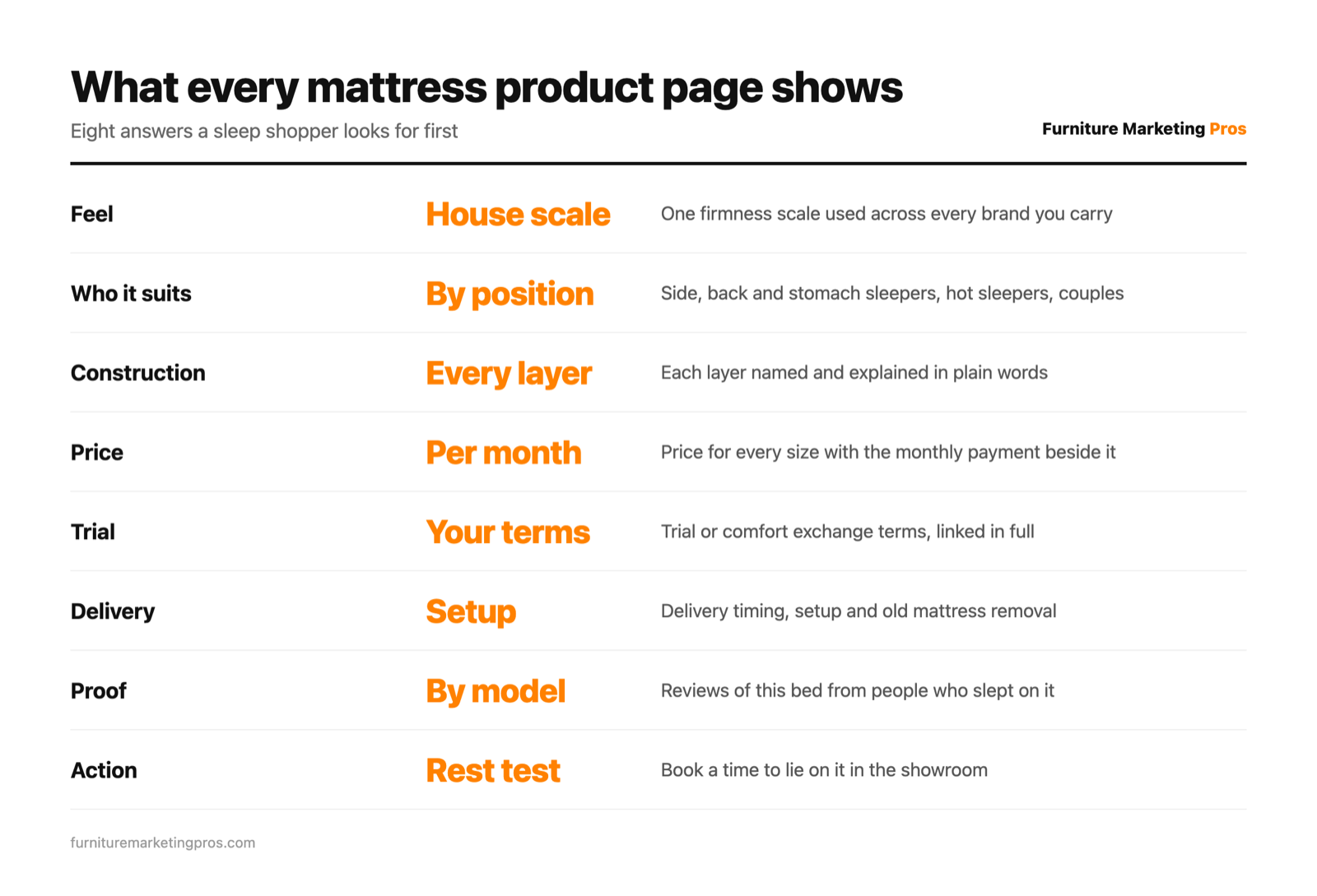
A rating on your own comfort scale, construction in plain words, the price for each size with the monthly payment, trial or exchange terms, delivery and removal details, reviews of that model and a button to book a rest test. Those answer the questions mattress shoppers ask most.
Should a mattress store website sell online or drive showroom visits?
Both, if you can fulfill online orders well. Most independent mattress retailers win more by making the rest test easy to book, because lying on the bed settles the doubt that stops shoppers buying online.
How can a local mattress store compete with online brands on its website?
Answer the same questions the online brands answer, honestly, then add what they cannot offer: a showroom to lie down in, fast local delivery with setup and removal, and a real person to help. Lead with those advantages instead of hiding them in a policy page.
Do mattress quizzes actually help?
They help when they are short and end in a shortlist of beds you carry plus a way to book a rest test. A long quiz that hides the result behind a form usually loses the shopper before the end.
How do I measure whether my mattress website is working?
Track rest test bookings, quiz leads, calls, direction taps, financing applications and online orders as conversions, then match them to sales in your CRM. Rising bookings and sales matter more than rising traffic.