




Most furniture store owners judge their website the way they judge the showroom floor: does it look good? It is the wrong test. A beautiful site can lose shoppers on every page and a plain one can fill the appointment book, because the furniture decision is made during online research and the website is where most of that research happens.
When we audit a furniture retailer's site, we are not grading the design. We are looking for the places where a shopper with real intent arrives, looks for an answer, does not find it and leaves. Those places are remarkably consistent from store to store, which is why the same 25 checks catch most of them.
Here is the audit we run, grouped into seven areas, with what a pass looks like for each point and the order we fix things in. You can run all of it yourself with a phone, a laptop and an afternoon.
The short answer
A furniture store website audit checks whether a shopper with real intent can get every answer they need and take the next step without friction. The 25 points cover seven areas: speed and mobile, navigation and search, product pages, price and financing, trust, local and showroom signals, and conversion and tracking. Score each point pass or fail on a real phone. Fix speed, tracking, missing prices and dimensions and the monthly payment first, because those decide whether anything else is ever seen or measured. Then judge the result on inquiries, booked appointments, showroom visits and sales, not on traffic.
How to run the audit in one afternoon
Set it up the way your shoppers experience the site, not the way you see it on the office computer.
Use a phone on cellular data. Turn wifi off. Most shoppers who find you through search or social are on a phone, and the office connection hides problems they feel immediately.
Pick five real pages. The homepage, your busiest category page, two of your best selling product pages and your contact or location page. Together they cover almost every path a shopper takes.
Play a real shopper. Give yourself a task, such as finding a queen bed within a set budget that can be delivered this month, and notice every moment you hesitate.
Score honestly. Each point is a pass or a fail. Partial credit hides the problem. Write down what you saw beside every fail, because the note becomes the fix list.
This is a conversion audit. Rankings, metadata and site structure are a separate job, covered in our furniture store SEO audit checklist. Run both, but keep them apart, because a page can rank well and still send every visitor away.
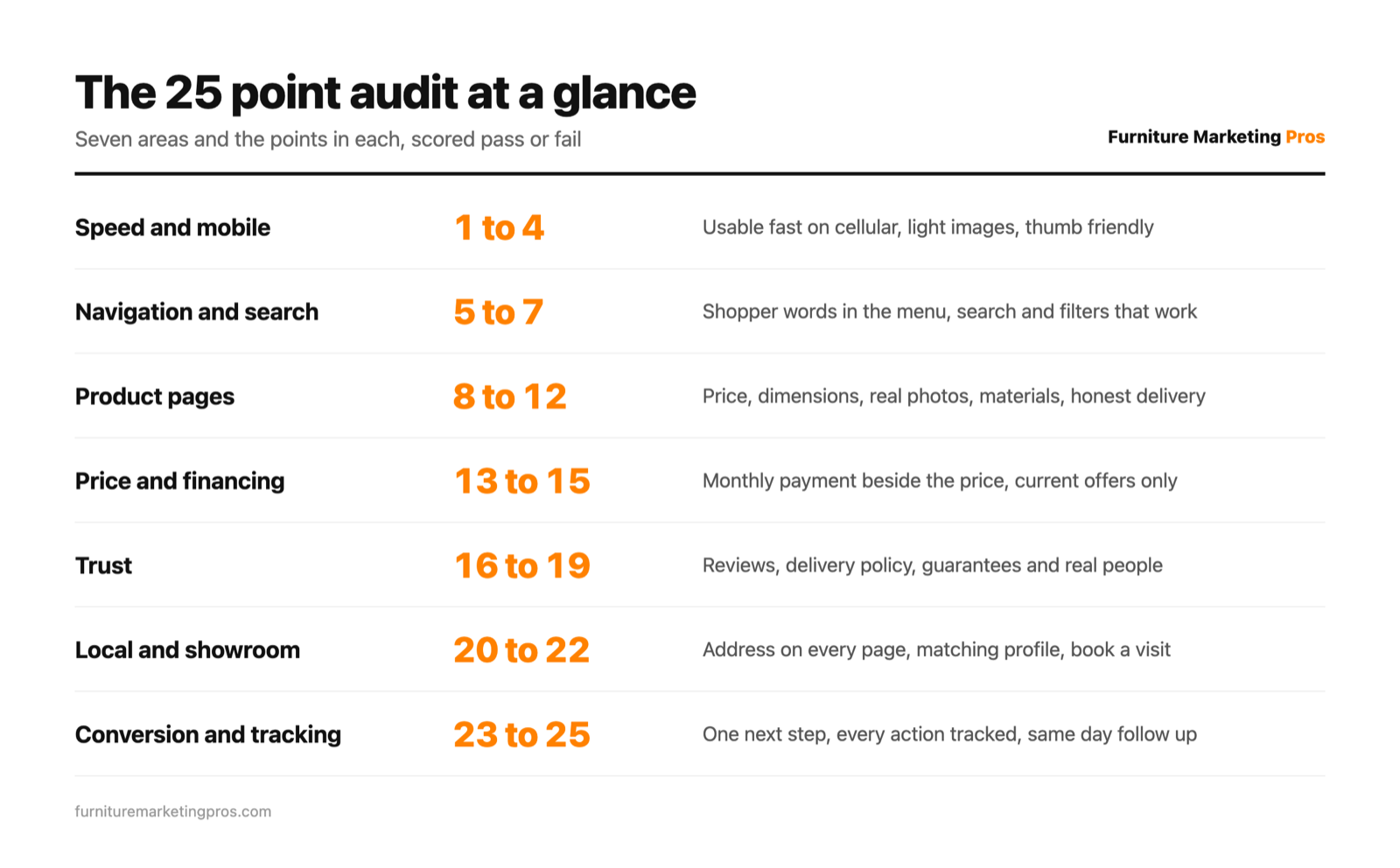
Speed and mobile: points 1 to 4
1. The page is usable within a few seconds on cellular. Open each of your five pages on the phone and count. If you are staring at a blank screen or a slideshow that will not settle, so is your shopper, and many of them will not wait.
2. Core Web Vitals pass in Search Console. Google measures three things on real visitors' devices: how quickly the main content appears (Largest Contentful Paint), how quickly the page responds to a tap (Interaction to Next Paint) and how much the layout jumps while it loads (Cumulative Layout Shift). Google treats a Largest Contentful Paint under 2.5 seconds as good. Search Console shows which of your pages pass and which fail.
3. Images are compressed and sized for the screen. Furniture sites are image heavy by nature, and the most common cause of a slow furniture page is a product photo uploaded straight from the camera or the manufacturer at full size. Every image should be compressed, served at the size it displays and loaded lazily below the first screen.
4. Everything works with a thumb. Phone numbers tap to call, the address opens maps, buttons are large enough to hit, and no popup covers the page in the first seconds. Chat widgets and review badges that load before the content count against you here too.
Navigation and search: points 5 to 7
5. The menu uses shopper words, organized by room and category. Living room, bedroom, dining, mattresses and outdoor, with sectionals, sofas and recliners beneath. Not collection names from a manufacturer catalog, and not a menu that only makes sense inside your store.
6. Site search finds what people type. Search for a brand you carry, a misspelling of sectional, a size like king and a style like mid century. If any of those return nothing, shoppers who know exactly what they want are being told you do not have it.
7. Filters answer the real questions. Size, price, material, color, and in stock or ready to deliver. A category of two hundred sofas without a working filter is a wall, not a selection.
Product pages: points 8 to 12
Product pages are where furniture is actually sold online, and they carry the most points for that reason.
8. Every product shows a price. A shopper who has to call for a price usually does not call. If pricing varies by fabric or configuration, show a starting price tied to a named configuration.
9. Dimensions are complete. Width, depth, height, seat height and, for anything large, the measurements that decide whether it gets through a doorway or up a stairwell. The shopper is measuring their room while they read.
10. Photos are real, and there is video. At least one image of the piece in a real room, close ups of fabric and finish, and a short walkaround video. Real video of real products in real rooms beats catalog renders.
11. Materials, construction and care are explained. Frame, cushion fill, fabric, finish and how to look after it, in plain words. This is the information a considered buyer uses to justify the price.
12. Availability and delivery timing are honest. In stock, special order with a realistic lead time, or floor model. Nothing loses trust faster than a sofa that looked ready to deliver and turns out to be months away.
Our post on website design fixes that sell more furniture goes deeper on product photography and dimensions.
Price and financing: points 13 to 15
13. The monthly payment sits beside the price. Financing shown as a monthly payment on the product page and in the cart is among the most reliable reasons a furniture shopper takes the next step. Hidden behind a footer link, it does nothing.
14. A financing page explains the programs in plain language. Which partners you work with, the terms, what applying involves and a link to prequalify where your partner offers one. State terms honestly and never promise approval. Our guide to marketing furniture financing covers the wording.
15. Every offer on the site is current. Look for expired sale banners, a holiday promotion still live weeks after the holiday, or a sale page with no end date. An expired offer tells the shopper nobody is minding the store.
Trust: points 16 to 19
16. Reviews are visible on the site. Not only on Google. Show recent reviews from local customers near the top of key pages, with first names and towns where customers agreed.
17. The delivery policy is written down. Areas, fees, lead times, setup, removal of the old piece and what happens with tight stairs. It should be one tap from every product page.
18. Returns, warranties and guarantees are stated plainly. Shoppers buying a large piece they have not lived with want to know what happens if it does not work in the room. Vague answers read as no.
19. Real people and a real showroom appear. Photos of your team, your floor and rooms you have delivered. This is the one thing online only brands cannot copy, so show it.
Local and showroom signals: points 20 to 22
20. Address, hours and directions are on every page. In the footer at minimum, plus a location page with a map, parking details and a storefront photo. Stores with several showrooms need one page per location.
21. Your details match your Google Business Profile. Name, address, phone and hours should be identical on the site and the profile. Mismatches confuse shoppers and search engines alike, and our guide to fixing your Google Business Profile covers the profile side.
22. A showroom visit can be booked online. A visible book a visit button, a short form or a real calendar, and a confirmation that tells the shopper who will meet them. For a showroom retailer, the appointment is often the primary conversion.
Conversion and tracking: points 23 to 25
23. Every page has one clear next step. Book a visit, request a quote, call or buy. One primary action per page, with forms that ask only for a name, a phone or email, what they are shopping for and roughly when.
24. Every buyer action is tracked as a conversion. Form submissions, calls through a tracking number, direction taps, bookings, chat leads and financing applications. If an action is not tracked, you cannot tell which page, ad or season produced it.
25. Every lead reaches a person the same day. Submit a test inquiry on a Saturday evening and see what happens. Leads should land in a CRM built for furniture retail with an owner and a follow up, not in a shared inbox nobody checks over the weekend.
What to fix first
Fails do not carry equal weight. We fix them in this order.
First, anything that stops the page being seen or measured. Speed on a phone, points 1 to 4, and tracking, point 24. A slow page hides every other improvement, and without tracking you cannot prove any of them worked.
Second, the missing answers on product pages. Price, dimensions and the monthly payment, points 8, 9 and 13. These are usually content work rather than development work, and they are the questions shoppers ask most.
Third, the paths to the showroom. Directions, booking and same day follow up, points 20, 22 and 25, because that is where an online shopper becomes a visit.
Then everything else, in batches, one area per month.
Rerun the audit every quarter, and after any redesign, theme change or new app. Sites drift. A plugin update breaks a filter, a sale banner outlives its sale, and nobody notices until the audit does. Judge the work on inquiries, booked appointments, verified showroom visits and sales in a CRM, not on traffic or time on site. For the bigger picture of what a converting site does, see how to turn your furniture store website into a lead machine.
Run the same audit on two competitors
Once you have your own score, run the same 25 points on the two stores your customers mention most and on one national brand they compare you with. It takes another hour and it changes the conversation. You see exactly where a shopper comparing you side by side finds an answer on their site and silence on yours, whether that is a delivery date, a monthly payment or a way to book a visit.
Do not copy what you find. Use it to rank your fails. A point you fail and every competitor passes is costing you shoppers today, so it moves up the list. A point everyone fails is your chance to be the only store that gets it right.
Turning the audit into a working site
Most stores can fix the content points themselves. The speed, tracking and booking points usually need a developer who knows furniture retail, and that is the work our web development team does for furniture and mattress retailers, with the audit as the starting brief. If you would like a second pair of eyes on your score, book a strategy call and we will walk through your site with you.
Key takeaways
- A furniture website audit checks whether a shopper with intent can find every answer and take the next step, not whether the site looks good.
- Run it on a phone over cellular data, on five real pages, playing a real shopper with a real task.
- Product pages carry the most weight: price, complete dimensions, real photos and video, materials and honest delivery timing.
- Show the monthly payment beside every price and keep every offer on the site current.
- Track every buyer action as a conversion and make sure every lead reaches a person the same day.
- Fix speed and tracking first, then product page answers, then the paths to the showroom.
- Rerun the audit every quarter and after any redesign or new app.
Frequently asked questions
How long does a furniture store website audit take?
You can run all 25 points yourself in an afternoon with a phone and a laptop. Fixing the fails takes longer, usually about a quarter for a typical showroom site when the work is done in priority order.
What score should a furniture store website aim for?
Every point is achievable, so aim for all 25. In practice, fix the fails that stop pages loading, answering or being measured first, then work through the rest one area at a time.
Is a website audit the same as an SEO audit?
No. An SEO audit asks whether shoppers can find your pages in search, and a conversion audit asks what happens once they arrive. A site needs both, and fixing one does not fix the other.
Do I need a new website to pass this audit?
Usually not. Most fails are missing information, heavy images and untracked actions, which can be fixed on the site you have. A rebuild makes sense when the platform itself blocks prices, speed or booking.
How often should I audit my furniture store website?
Every quarter, and again after any redesign, theme change, new app or new financing program. Small changes break things quietly, and the audit is how you catch them before shoppers do.